
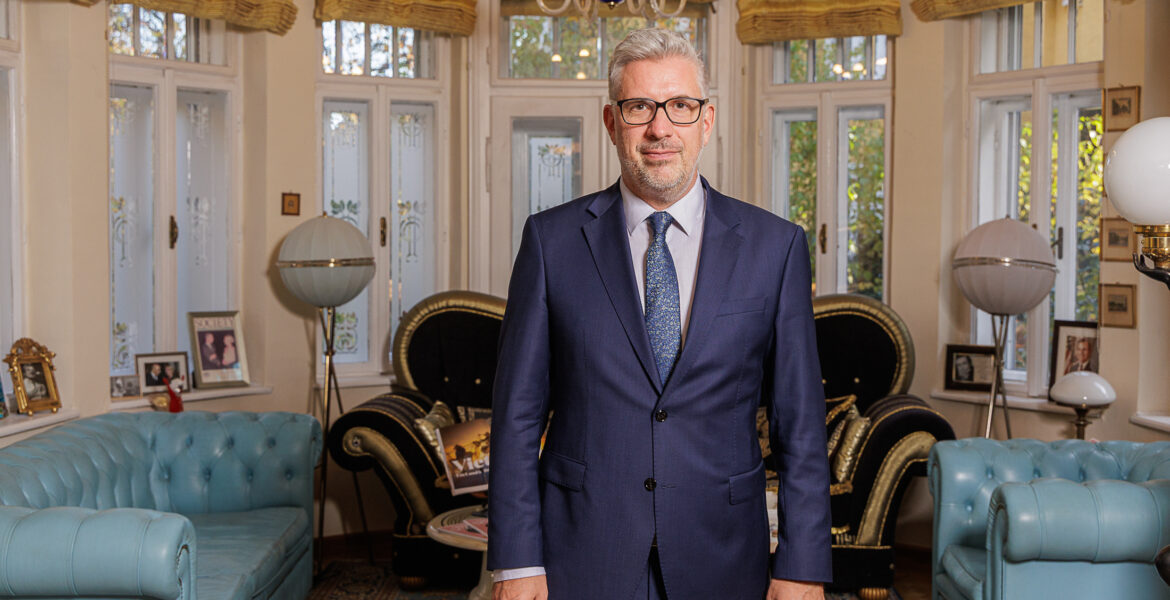
Diplomatic SOCIETY talked with H.E. Marko Štucin, Ambassador of Slovenia to Austria, about bilateral relations, the status of the Slovenian minority in Austria, Slovenia’s role within the EU and its foreign policy in times of global fragmentation.
Austria’s and Slovenia’s diplomatic relations date back to 1992. What are the main characteristics of the current ties and what influence did the events surrounding the “Peršmanhof Incident” in summer 2025 have?
Slovenia and Austria are friendly countries with exceptionally intensive cooperation in many fields, such as politics, economy, science, and culture. In just the past few months alone, the Slovenian President has visited Austria twice. The Austrian Federal President also frequently visits Slovenia. Similarly intensive meetings take place in all other formats as well.
As Slovenes we are educated in schools about our numerous Slovenian intellectuals who have left a significant mark on Austria. Examples include the first Bishop of Vienna, Slatkonja, the founder of the Slavic philology and Professor of Slovene language at University of Vienna as well as renowned Slovenian architects such as Plečnik, Fabiani, and Podrecca, who contributed several architectural gems in Vienna and other parts of Austria. Many Slovenian writers and poets studied and worked in Vienna. Nevertheless, coming to Austria and living here for more than six months, I realize anew almost every day how interconnected on all levels and areas our two countries are.
However, as with all neighbouring countries anywhere in the world, there are always topics that are less straightforward. One such issue is the status of the Slovenian minority in Austria, which has never been regulated in the manner laid down 71 years ago in the Austrian State Treaty. The minority in the bilingual area does not have properly regulated, easy access to bilingual courts. There are too few bilingual kindergartens and secondary schools, and incidents concerning visible bilingualism are frequent. The incident at the Peršman Museum, where last year Austrian authorities carried out a disproportionate and unlawful raid at a site that symbolizes Nazi crimes against the minority, is particularly troubling. This issue requires much more discussion in both Austria and Slovenia. Only through dialogue will we achieve a sufficiently high level of awareness of minority issues and, I hope, an adequate systemic regulation of minority rights.


Throughout your career, you have been regularly working on EU-related topics – how would you describe Slovenia’s role within the EU? And what are, in your opinion, the biggest challenges the EU is currently facing? What can small countries like Slovenia and Austria do to strengthen it?
In the 35 years of its independence and 22 years of membership in the European Union, Slovenia has managed to become a technologically advanced country with a high social standard. Within the EU, we have established ourselves as good experts on Central Europe and the Western Balkans. The European Union often discusses and also adopts solutions proposed by our country, both regarding the internal market and foreign policy. We strive for dialogue and constructive cooperation. At the same time, we are often critical of excessive regulation in the EU, slow decision-making processes, and the Union’s inability to become a significant global player.
Slovenia and Austria are highly export-oriented economies that depend heavily on the proper functioning of the EU’s internal market. More Europe should be in our strong interest, as it increases the prosperity of our citizens. We also need more Europe for security reasons. We no longer live in a peaceful neighbourhood, and we can only defend ourselves against numerous threats together. These two issues—better coordination in the economic field and better and faster coordination in the field of security—represent our greatest challenges.
Smaller member states are particularly aware of these challenges. Together, we must convince sceptics in a constructive yet determined manner that the existence of the EU is in our national interest, as membership makes us significantly stronger. In the coming period, we face intensive negotiations on the common multiannual European budget, which will play a crucial role in shaping the direction Europe will take.
Given the current geopolitical rifts – is Slovenia planning on adapting its foreign policy, respectively, what are your country’s core foreign policy principles?
At the end of last year, Slovenia concluded its two-year membership in the United Nations Security Council. During this period, we were deeply involved in all key debates on conflicts around the world. In these discussions, Slovenia primarily supported the peaceful resolution of disputes and the respect for human rights. This engagement went beyond mere principled statements; among other things, we worked intensively within the informal group of non-permanent members of the Security Council to translate this perspective into concrete solutions. We will continue this engagement in the coming period in the UN Human Rights Council, to which we have been elected, as well as in all other International Organizations.
Unfortunately, we are living in a time of the erosion of the international political order and international law. Arguments for peace are no longer being heard. Raw power is increasingly dominating international relations. This is a dangerous trend for smaller countries, as we depend on cooperation and the ability to reach agreements. I argue that this trend is ultimately dangerous even for major powers, as conflicts never bring prosperity but instead lead to societal regression. Diplomacy bears the responsibility of demonstrating that dialogue is a far better alternative.
To move on to a more pleasant topic: Slovenia experienced a significant tourism boom in 2025 – how important is the tourism sector for the country’s GDP and which role is sustainability playing in this regard?
Slovenia is a green country, with almost two-thirds of its territory covered by forests. From Ljubljana, you can reach the high Alps or the Adriatic coast within an hour. The most visited tourist destinations include alpine lakes such as Bled and Bohinj, towns on the Adriatic coast such as Izola and Piran, as well as Ljubljana and other cities. Tourists also like to visit attractions such as the Postojna Cave or the Lipica Stud Farm, which gave the name to the Lipizzaner horses and is their breeding cradle. Slovenia also became a top gourmet destination with many Michelin star restaurants and excellent Slovenian wine. We have all the natural conditions and developed capacities needed for Slovenia to establish itself as a tourist destination attracting visitors from all over the world. Data for 2025 show that tourism contributed 8.6% of GDP, and this percentage is increasing year by year.
Ecological sustainability is, of course, a major challenge—not only in tourism but in general. In Slovenia, we aim to preserve our natural environment, and numerous measures have been adopted at both the local and national levels in recent years to ensure that Slovenia remains a sustainably managed country despite tourism development.
Vienna is less than two hours by car from the Slovenian border, so I would like to take this opportunity to invite readers to come and experience the beauty of Slovenia for themselves.