
Since being elected Director General of the International Atomic Energy Agency in 2019, the Argentinian Rafael Mariano Grossi has been one of the world’s most important and influential diplomats, ensuring the safe and peaceful use of nuclear technology.
by Sarah Heftberger
On a windy November afternoon, we meet the 64-year old career diplomat on the 28th floor of the United Nations office. Overviewing Vienna – the city he calls home for more than 16 years now – we talk about his career, his upbringing in Argentina, challenges he faced and moments that shaped him.
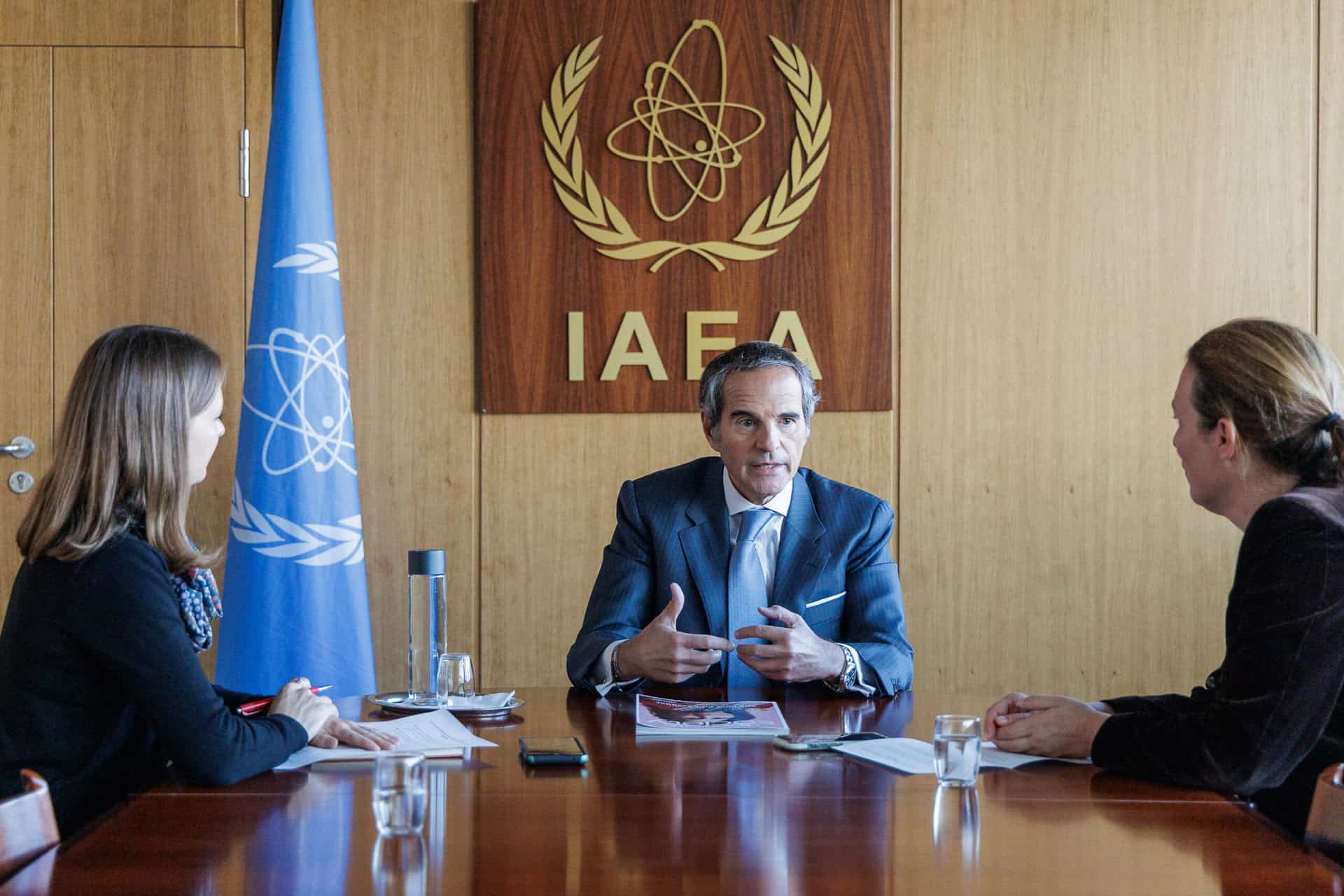
Right at the beginning, he tells us that the idea to become a diplomat and join the Foreign Service came to him quite early on in his life. He had always been passionate about history and international relations and was thinking about ways to turn this inclination into a profession. Even though he considered becoming a journalist or a university professor, he soon understood that he wanted to be on the “action side” of things. So besides studying Political Sciences at the Pontifical Catholic University of Argentina, and later earning a Master’s Degree and PhD in International Relations, International History and Politics from the University of Geneva, Graduate Institute of International and Development Studies, he also attended the Diplomatic Academy in Argentina. Eventually, in 1985, he entered the Argentine Foreign Service. It was in the same year that his path led him to Vienna – and to the IAEA – for the first time.
As a Disarmament Fellow and together with a group of young diplomats from around the world, he visited the atomic agency’s head office. “The IAEA was a really technical place back then that was never in the news”, he remembers. “And who would have thought that, one day, I would be the head of this very agency?”
It was also in the beginning of his career that he met the person that – career-wise – shaped him the most. Grossi was working as a young staffer in the Directorate of Nuclear Affairs and Disarmament of the Argentine Foreign Ministry when his path crossed with that of the first director of the department, Adolfo Saracho. “He became a real mentor to me and influenced my perspective on how to do things. I looked in admiration to him – how he worked and how he managed conflicts and until today, I think a lot about him”, he tells us.
During the same time, his home country Argentina found itself at a turning point in history: only a few years before, the brutal seven-year dictatorship of General Jorge Rafael Videla had collapsed, leaving the country in search for a new democratic identity.
Being a young diplomat at such a crucial time shaped Grossi enormously. “Argentina was still toying with the idea of having nuclear weapons and refused to sign the Non-Proliferation Treaty and I felt like I was working to help leading our country on the right path”, he says. Grossi was, for example, accompanying the presidents of Argentina and Brazil to a secret nuclear facility. “I was in the middle of things at such a young age and this really made me realize that change was possible indeed. This helped me have the enthusiasm and the sensation that you can do good things.”
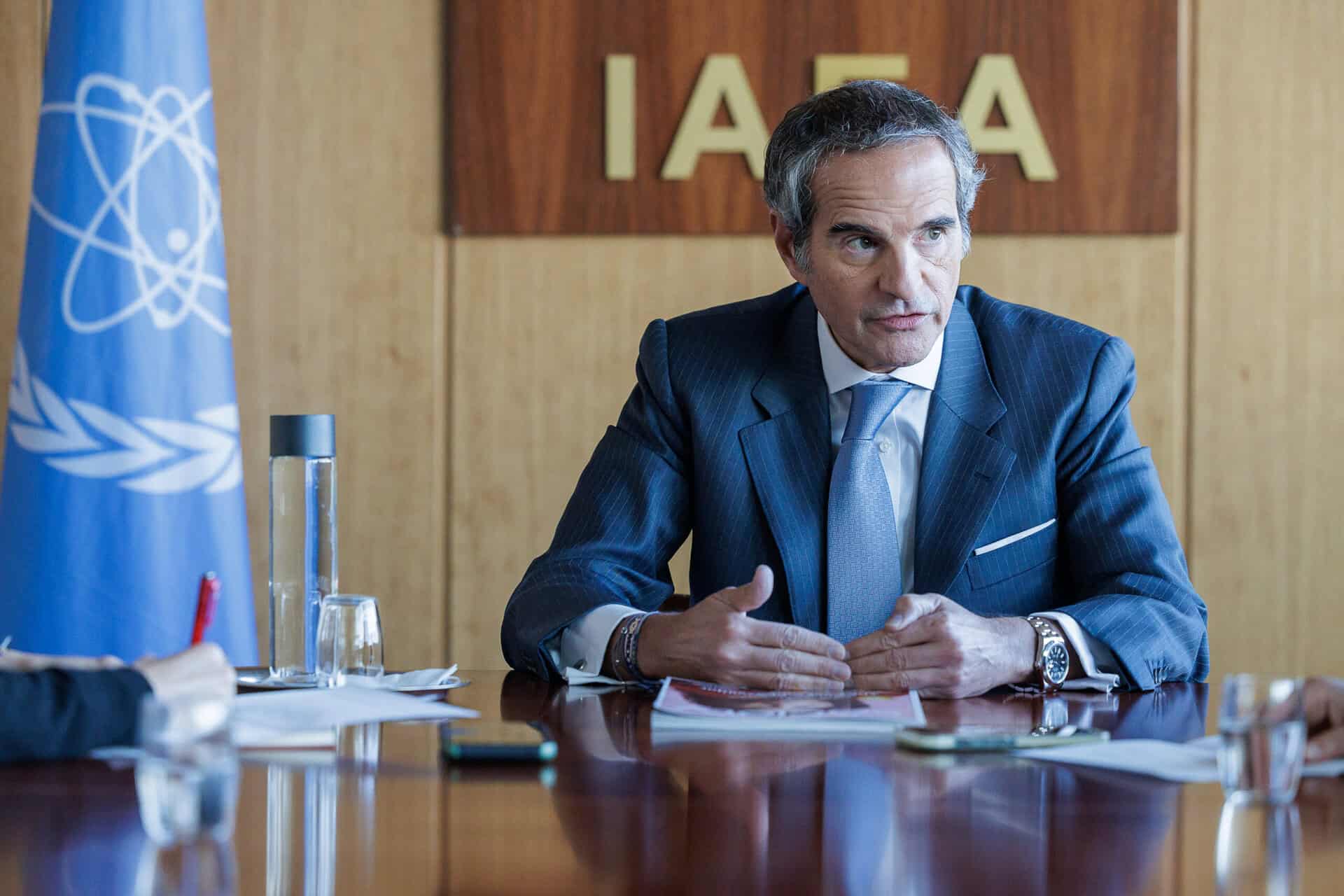


Finding his professional DNA
Over the course of his career, topics like science, technology, nuclear weapons, chemical weapons, non-proliferation and security policy seemed to constantly re-appear, evolving into his professional “DNA”. He, for example, served as the Argentine Representative to NATO, as the Chief of Cabinet at the Organization for the Prohibition of Chemical Weapons (OPCW) in The Hague, as Assistant Director General for Policy and Chief of Cabinet at the IAEA under the late Director Yukiya Amano, and Ambassador of Argentina to Austria and Argentine Permanent Representative to the IAEA and other Vienna-based International Organizations. In 2015, Grossi presided over the Diplomatic Conference of the Convention of Nuclear Safety, in the framework of which he secured unanimous approval for the Vienna Declaration on Nuclear Safety – a landmark achievement. Furthermore, he was the first president of the Nuclear Suppliers Group to serve two successive terms.

Ultimately, all of these experiences culminated in his election as IAEA Director General in 2019. “I was convinced that, aiming high, I could make a difference”, he explains when we ask him if he ever pictured his career like it is now.
Childhood in Argentina
Even as a young boy growing up surrounded by books and arts in the Almagro neighbourhood of Buenos Aires, he knew that he, one day, wanted to see the world and “make a change”.
His father – a writer and journalist – used to take him and his brother to the TV and radio stations he was working for – something Grossi remembers as a “fantastic experience”. “I think I learned a lot about communication there and this definitely had an influence on me and my view on what I wanted to do later”. With his mother – a sculptress – he spent hours playing with clay in her home studio and observing her while she created her pieces of art. “They were always incredibly supportive and really open-minded”, he adds. The creativity of his parents “definitely” helped him in his career – the “meticulous and artistic” work of his mother and the communication skills of his father as well as their insistence on learning languages shaped him profoundly. “I will always be grateful to them for that because they really opened my mind”.
Then, when Grossi was just 15 years old, a military junta led by General Jorge Rafael Videla took power in Argentina, committing widespread crimes against humanity throughout its seven-year dictatorship. “There was the appearance of a relative normalcy but, of course, terrible things were happening at the same time”, he remembers in an interview with Melissa Fleming for UN Web TV. While he went to school and attended football matches, he knew that something was “fundamentally wrong”.
Shortly before Argentina’s return to democracy in late 1983, the military regime had announced that it had mastered uranium enrichment – a shock to the international community as the country had not yet signed the Non-Proliferation Treaty and the uranium had been enriched in a secret facility.
At that time, Grossi was 22 years old. He participated in political rallies, “chanting and screaming”. After the fall of Videla’s regime, the days were filled with “tremendous hope and relief.” “It was like a new life for all of us. There was lot of hope (…) those years were the years of the rebirth of our country and at the same the beginning of my diplomatic career”, he recounts. (UN Web TV, 10.12.2021).
IAEA Director General
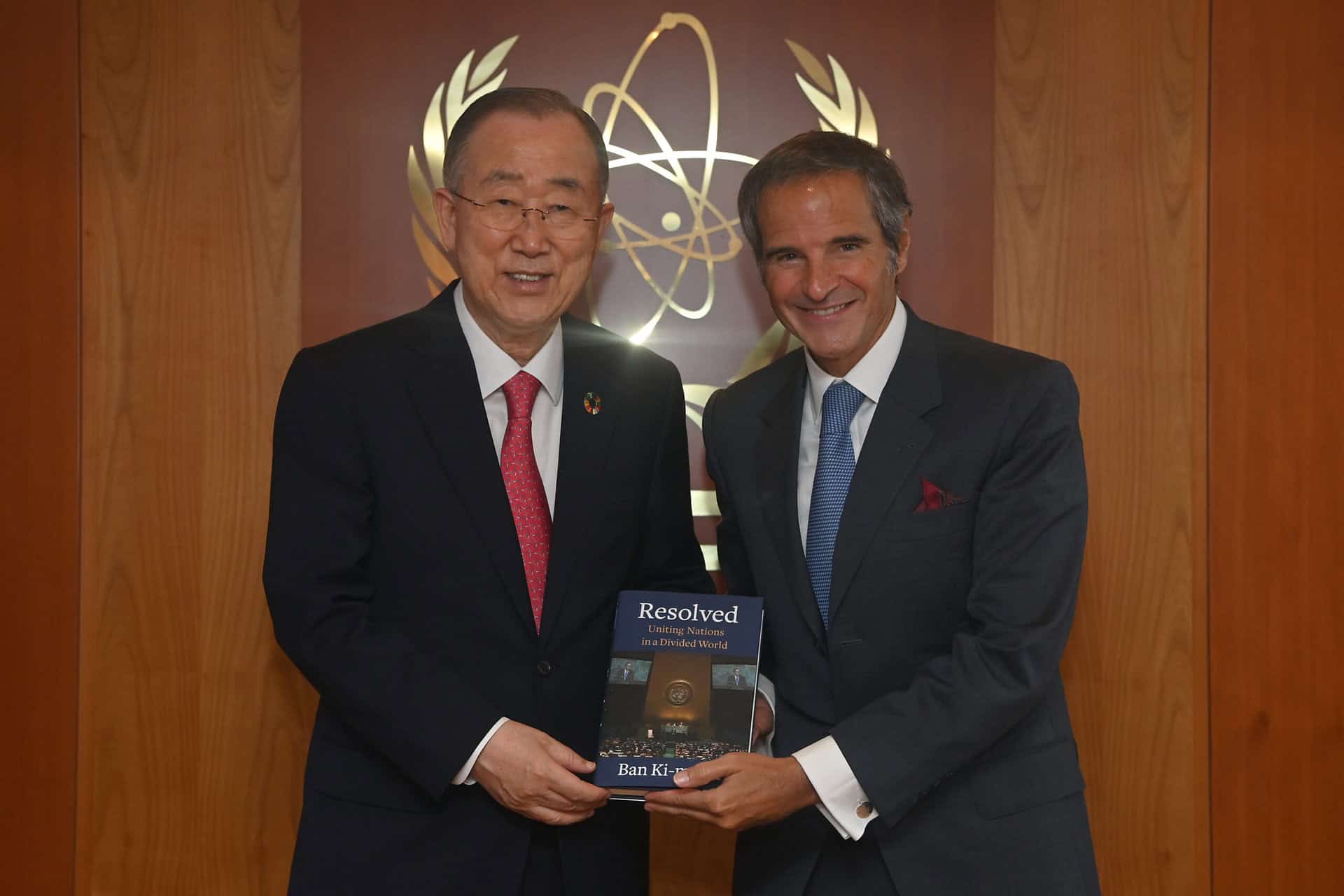
36 years and a variety of experiences later, he became one of the key figures in international diplomacy when he assumed office as the first ever Latin American Director General of the IAEA on December 3, 2019. Before that, he had won unanimous support from the organization’s member states. Asked if he ever regretted taking on this position, he replies without hesitation that he “never” did, adding that “it is something that I would do all over again” – despite the fact that he was faced with a number of challenges throughout the last six years in office.

One day stands out in particular when Grossi speaks about pivotal experiences as Head of the IAEA: September 1, 2022, the day he and other IAEA experts went to Ukraine – in the midst of the war – to deploy the first ISAMZ team at the Zaporizhzhia Nuclear Power Plant after intense fighting had been reported around the site. When he and his team approached the front line, they came under fire. “We stopped immediately and my chief of security asked how I wanted to proceed. At that moment, I felt a heavy responsibility on my shoulders – for our lives and also for our whole mission”, he tells us. “Then I said to myself: If we come here and then just turn back, those who wanted to avoid this mission in the first place will have won forever. And so, I told my team that I want to proceed but that they were free to go”. All team members decided to stay. “This felt like a unique moment and I knew that we were doing something that was really important.”
Key achievements
Later, he played a crucial role in establishing a “Nuclear Safety and Security Protection Zone” around the Zaporizhzhia plant by engaging with both Russia and Ukraine. However, the risk of a nuclear accident continues to be big. “Until the war stops, there is a ceasefire or the guns are silenced, there is always a possibility of something going very, very wrong”, Grossi said in an interview on November 25.
The IAEA is providing support and assistance to Ukrainian nuclear facilities all over the country, and “the parameter of our success or lack thereof, will be to make it to the moment when there is a general ceasefire without having had a nuclear accident”, he tells us.
Looking towards Iran, he says that it is “indispensable to reach a new deal so that Iran can have nuclear civil activities under a very stringent verification carried out by the IAEA”. In our interview, Grossi emphasizes the need to keep diplomatic channels open at all times – and that the IAEA “will try to bring the involved parties together”.
Even though Iran and Ukraine are occupying most of the headlines when it comes to nuclear technology and safety, there are numerous other areas of focus the IAEA – and Rafael Grossi – are working on.
He, for example, also engaged with both Japan and China to reach a four-point agreement following a dispute regarding the controversial release of nuclear-contaminated water by Japan. In the area of health and food security, Grossi launched the “Rays of Hope Initiative” to provide lifesaving cancer treatment and training, as well as – together with FAO Director-General QU Dongyu – the “Atoms4Food” to help countries boost food security and tackle hunger through the innovative use of nuclear and isotopic techniques.
For his success in achieving gender parity within the IAEA three years earlier than a target set by the UN, Women in Nuclear awarded him with the “2025 Changemaker of Distinction Award”. Ever since he became IAEA Director General, he implemented a number of measures as well as programmes to reach equal representation, which led to him being invited to join the Board of the International Gender Champions in 2020.
Further, he works to position the IAEA as a key player in climate change discussions, emphasizing the role of nuclear power to mitigate climate change and promoting the use of small modular reactors to generate clean energy.
The cost of a career
However, being one of the most influential diplomats in the world does not come without costs. When in August this year, Iran accused the IAEA of aiding US and Israeli airstrikes on three nuclear facilities, Grossi had to get special police protection from the Austrian police unit Cobra.
Moreover, he tells us that to manage a balance between his career and his family is “extremely difficult”. Seven out of his eight children are living abroad, only his smallest child – his only son – is still in Vienna. “I try to see them whenever I can but it is very difficult. Without exaggerating or victimizing myself, I have a job that leaves very little space for a private life. My phone may ring at any moment, be it night or weekend.” Nonetheless, the “Estudiantes de La Plata” supporter managed to find the time to coach the football team his son was part of. “I did it because it was a nice opportunity to be close to my son and further than that, it turned out to be a very intimate way to the soul of the city”, he adds.
When we ask him about his life in Vienna and what the city means to him, he raves about the experiences he has had in the Austrian capital: “I enjoy life here enormously. I have learned to appreciate what the city offers in terms of conviviality and I might even retire here because it is a place in which I made a lot of friends too”.
The next step

Yet, once he achieves his next goal – to succeed António Guterres as UN Secretary-General – he would need to leave Vienna. “That would be the only bad thing about it”, he smiles. But for Grossi, putting his life in service of the world is only natural. “I believe in the UN and at the same time I think that it is in trouble. We should not hide the fact that there is a lot of dissatisfaction about it(…). My goal would be to bring the UN back to the centre of the international peace and security agenda and I think that what I do now has prepared me well for a challenge like this”, he emphasises.
Whether Grossi will become the tenth Secretary-General of the United Nations will be decided in the course of 2026. The avid reader of biographies and memoirs undoubtedly has the skillset.
Photos: Dean Calma/IAEA//Diplomatic SOCIETY/Pobaschnig//www.president.gov.ua
Read the whole magazine by clicking here.