
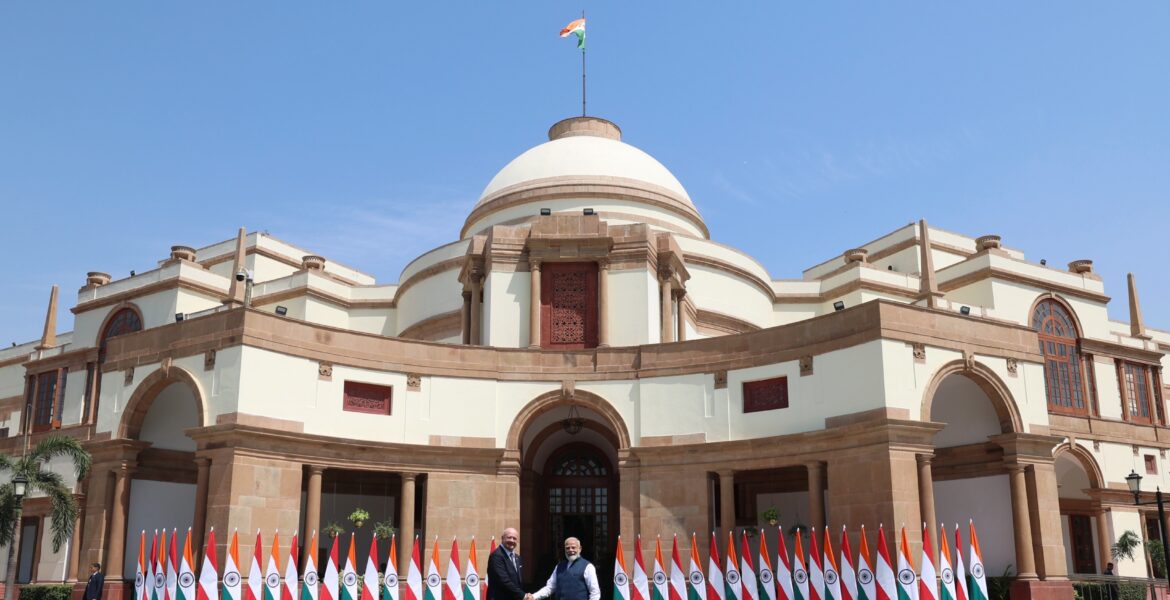
He was sworn-in as India’s Prime Minister (PM) for the third time on June 9, 2024, following another decisive victory in Parliamentary elections, marking the third consecutive term as Prime Minister and further solidifying his leadership of the world’s largest democracy.
Text provided by the Indian Embassy in Vienna
Shri Modi’s leadership and vision for the country focuses on a blend of economic development, national security, and social welfare programs, building on the foundations laid during his previous tenures that emphasised technological innovation, infrastructure development, and international diplomacy.
The first ever PM to be born after independence, Shri Modi previously served two terms as PM, from 2014 to 2019 and from 2019 to 2024. He also has the distinction of being the longest serving Chief Minister of the state of Gujarat from October 2001 to May 2014.
Inspired by the motto of ‘Sabka Saath, Sabka Vikas, Sabka Vishwas, Sabka Prayaas’, (Everyone’s Support, Progress, Trust and Effort) Shri Modi has ushered in a paradigm shift in India’s governance, one that is inclusive, development-oriented and corruption-free. He has worked with speed and scale to realise the aim of Antyodaya, or ensuring last-mile delivery of schemes and services.
“My mantra is reform to transform, and I say in my government—Reform, Perform and Transform.” Narendra ModiLeading international agencies have noted that under the leadership of PM Modi, India has been eliminating poverty at record pace. According to the findings from NITI Aayog’s latest report ‘Multidimensional Poverty in India since 2005-06’, India has elevated more than 250 million people from poverty in the last decade.
Today, India operates the world’s largest healthcare programme, Ayushman Bharat, covering over 500 million Indians and providing quality and affordable healthcare to the poor and neo-middle class.
Understanding that financial exclusion was a bane for the poor, PM Modi launched the ‘Jan Dhan Yojana’ aimed at opening bank accounts for every Indian. Over 510 million Jan Dhan accounts have since been opened, not only securing financial inclusion, but also opening the doors for several other avenues of empowerment through the JAM trinity (Jan Dhan – Aadhaar – Mobile), ensuring transparency and speed in governance, powered by digital technology.
On October 2, 2014, Mahatma Gandhi’s Birth Anniversary, PM Modi launched the ‘Swachh Bharat Mission’, a mass movement for cleanliness across the nation. The scale and impact of the initiative is historic. Today, sanitation coverage has risen from 38% in 2014 to 100% in 2019.
Under PM Modi, India has seen one of the greatest infrastructure build-ups ever, creating next-generation highways, railways, i-ways and waterways as well as the UDAN Scheme to make aviation more people-friendly and boost connectivity. PM Modi’s PRAGATI (Pro-Active Governance And Timely Implementation) has expedited pending projects that were delaying growth.
PM Modi also launched the ‘Make in India’ initiative in 2014 to turn India into a manufacturing powerhouse, which has led to transformative results. India has made significant strides in ‘Ease of Doing Business’. India rolled out the Goods and Services Tax (GST) in 2017, realising the dream of ‘One Nation, One Tax.’
PM Modi is deeply passionate about environmental causes. As Chief Minister of Gujarat, Shri Modi created a separate Climate Change Department. This spirit was seen in the 2015 COP21 Summit in Paris where PM Modi played a key role in the high-level deliberations. Going a step ahead of climate change, PM Modi has talked about climate justice. In 2018, Heads of State and Government from several nations came to India to launch the International Solar Alliance, an innovative effort to harness solar energy for a better planet. Recognising his efforts towards environmental conservation, PM Modi was honoured with the United Nations ‘Champions of the Earth Award.’
Shri Modi’s foreign policy initiatives have realised the true potential and role of the world’s largest democracy. He began his first term in office in presence of all Heads of States of SAARC Nations and invited BIMSTEC leaders at the start of the second term.
Since taking over, Shri Modi has attended various UN, BRICS, SAARC and G-20 Summits, where India’s interventions and views on a variety of global economic and political issues are widely valued.
Narendra Modi’s clarion call for marking an ‘International Day of Yoga’ received an overwhelming response at the UN. In a first, a total of 177 nations came together and passed the Resolution declaring June 21st as the ‘International Day of Yoga‘.
Early life
Born on September 17, 1950, in a small town in Gujarat, PM Modi’s family belonged to the marginalised sections of society. He grew up in a poor but loving family. The initial hardships of life not only taught the value of hard work but also exposed him to the avoidable sufferings of the common people. This inspired him from a very young age to immerse himself in service of people and the nation. In his initial years, he worked with the Rashtriya Swayamsevak Sangh (RSS), a nationalist organisation devoted to nation building and later devoted himself to politics working with the Bharatiya Janata Party.
Techno-Savvy Popular Leader
Narendra Modi is a ‘People’s Leader’, dedicated to solving their problems and improving their well-being. His powerful ‘personal connect’ with the people on ground is complemented by a strong online presence. He is known as India’s most techno-savvy leader, using the web to reach people and bring about change in their lives. He is very active on social media platforms.
Beyond politics, Narendra Modi enjoys writing. He has authored several books, including poetry. He begins his day with Yoga, which strengthens his body and mind and instils the power of calmness in an otherwise fast-paced routine.