
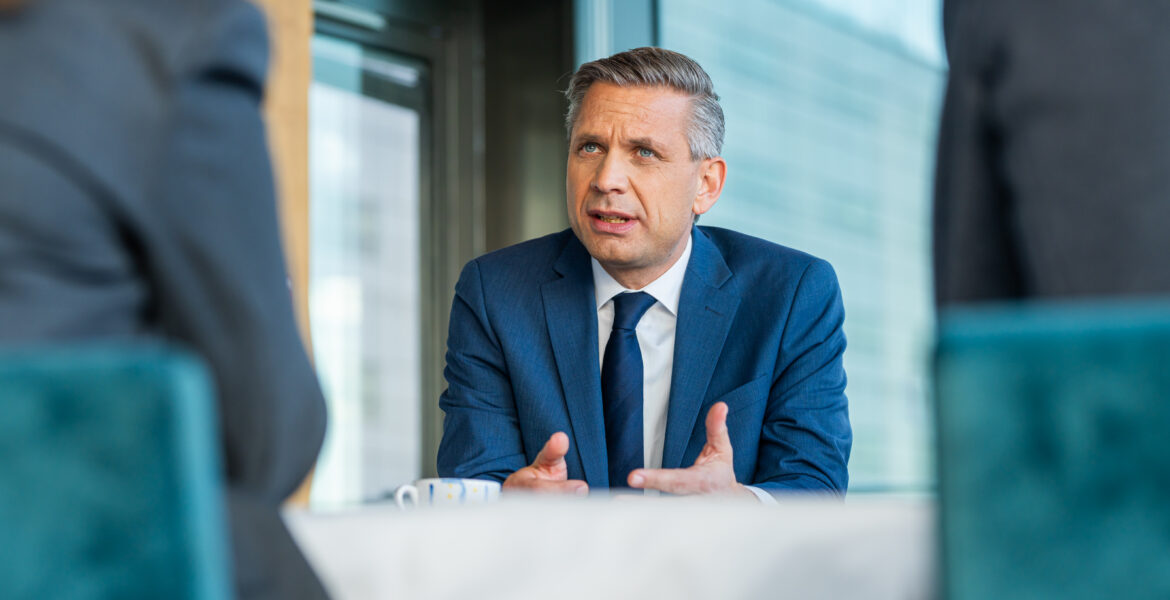
In mid-April this year, a large Austrian business delegation headed by Federal Chancellor Christian Stocker and Minister of Economy Wolfgang Hattmannsdorfer visited India. The two countries have enjoyed good and trusting relations for almost 80 years. This was emphasized both by the Austrian side and by India’s Prime Minister Narendra Modi during the talks.
The economic opportunities for Austria in this country of 1.5 billion inhabitants are far from being fully exploited, even though bilateral trade volume has doubled over the past ten years to almost 3 billion euros. With a growth rate of 7 percent, India is one of the most dynamic markets in the world. The India-Austria Business Summit held in New Delhi is intended to provide new momentum for stronger cooperation. Robert Stoppacher from Diplomatic SOCIETY spoke with Economy Minister Wolfgang Hattmannsdorfer about the prospects of this dialogue.
Minister Hattmannsdorfer, India, with almost 1.5 billion inhabitants, is a highly attractive market for Austria and the entire European Union. How has trade between the two countries developed in recent years?
Austria is an export-oriented economy. Six out of every ten euros are earned through exports. Especially in a geopolitically challenging time, we need to strengthen our position where growth is being generated. India is exactly such a market: large, dynamic, and offering enormous potential for Austrian companies.
Bilateral trade volume has doubled over the past ten years to almost 3 billion euros. Austrian exports to India recently reached around 1.5 billion euros – an increase of 13.6 percent. This shows that India is not a distant market of the future for Austria, but a concrete opportunity for growth, value creation, and jobs.
Our goal is clear: we want to double Austrian exports to India in the coming years. This requires new markets, strong partnerships, and fair framework conditions. A free trade agreement between the EU and India could be a decisive step forward.
Which Austrian products are particularly interesting for the Indian market?
Demand is focused on precisely what Austria does best: mechanical engineering, industrial expertise, technology, green technologies, and high-quality specialized solutions. Recently, machinery and vehicles have been particularly successful, with growth of 30.3 percent, as well as chemical products, which increased by 49.2 percent.
India is investing heavily in industry, infrastructure, and energy. This represents a major opportunity for Austrian companies because we are internationally competitive in these areas. Through stronger cooperation in key sectors such as industry, technology, green technologies, and infrastructure, we can further expand export growth.
Our goal is clear: to position Austrian quality more strongly in growth markets and thereby secure production, employment, and value creation at home.
Which goods does Austria import from India?
Austria mainly imports clothing, footwear, electrical equipment, telecommunications technology, and textiles from India. At the same time, India is undergoing strong industrial development.
This means that the economic relationship is becoming broader and more technology-oriented. It is therefore crucial that Austria establishes strategic partnerships early – not only when others are already present. Austria should be a first mover in India. Those who enter new markets early secure competitive advantages.
What prospects arise from strengthening economic cooperation?
The trip to India was intended to initiate new projects, facilitate investment, and support Austrian companies entering the market.
India is growing rapidly – and that is precisely where the opportunities for Austria’s economy lie. The outlook is clear: more export opportunities, more investment, and more growth for Austrian companies. Around 160 Austrian companies are already active in India, and the number is expected to rise to around 170 by the end of the year. The unused export potential is estimated at around 1.18 billion euros by 2030.
That is why we must continue to strongly promote the EU-India Free Trade Agreement. Such an agreement could increase Austrian exports to India by around 75 percent and create around 5,000 additional jobs in Austria. This is modern location policy: opening markets, using opportunities, and strengthening competitiveness.
Was your visit alongside Chancellor Stocker a kind of door opener for Austrian companies?
Yes, absolutely. Such trips are not an end in themselves; they are economic policy door openers. I also see myself as the Republic’s first sales representative: our task is to open doors for Austrian companies, develop new markets, and use opportunities for growth, value creation, and jobs in Austria.
We received very positive feedback from companies. One company has already decided to establish its own sales subsidiary in India. That is exactly what this is about: creating a presence in new markets and thereby strengthening value creation, production, and jobs in Austria.
The agreed fast-track mechanism is also important. It is intended to resolve problems faced by Austrian and Indian companies more quickly. Less bureaucracy, more speed, and better conditions – this is exactly the approach we need.
Energy cooperation was also discussed. What could this involve?
India is growing rapidly – and with this growth, its energy demand is increasing enormously. At the same time, India wants to diversify and make its energy supply more sustainable. This is where major opportunities for Austrian companies lie.
Our companies have internationally recognized expertise in energy infrastructure, hydropower, pumped-storage facilities, renewable energies, and industrial specialist solutions. One example is Andritz: the company is involved in seven pumped-storage projects in India, covering around 70 percent of the Indian market. This demonstrates that Austrian technology can make a real difference in India.
Energy policy is also foreign economic policy: when India invests, Austrian companies must be among those at the forefront.