
From motorcycle adventurers and academic exchange programs to a legendary conductor and an Indian Nobel Peace Prize laureate visiting Austria, the ties between India and Austria are as diverse as they are fascinating.
Max Reisch – Reaching India by Motorcycle
In 1933, Max Reisch, a student of economic geography from Kufstein, set off from Vienna on his six-horsepower Puch 250 T motorcycle, equipped with an unsprung rear wheel, bound for India. Fascinated by the idea of becoming the first person to reach the distant country by motorcycle overland, he and his travel companion Herbert Tichy covered an incredible 13,000 kilometers in approximately six months before finally arriving in India—or the “beckoning distance,” as Reisch would later call it in his book. Armed with a large-format camera and a typewriter, but without GPS or modern navigation aids, they made their way through the Balkans, Turkey, Syria, Iraq, Iran, and Afghanistan before reaching Mumbai.
Zubin Mehta – Deeply Rooted in Vienna
The connection between the renowned Indian conductor Zubin Mehta and Vienna is a true musical love story. At the age of just 18, he moved to the Austrian capital and studied piano, composition, and double bass at the Vienna Academy of Music. He also completed conducting studies under the legendary Professor Hans Swarowsky. Over the following decades, Mehta celebrated historic successes with the Vienna Philharmonic Orchestra, conducted the famous New Year’s Concert five times, and was regularly featured by Austria’s public broadcaster ORF through concert recordings and interviews. Mehta once described Vienna as his true musical home and referred to himself as “a Viennese who happened to be born in India.” In April of this year, he celebrated his 90th birthday. In his honor, the Vienna Philharmonic—of which he has been Honorary Conductor since 2001—performed a birthday concert featuring works by Bruch, Weber, and Beethoven, commemorating nearly 400 concerts and more than 65 years of collaboration.
Bollywood in Austria
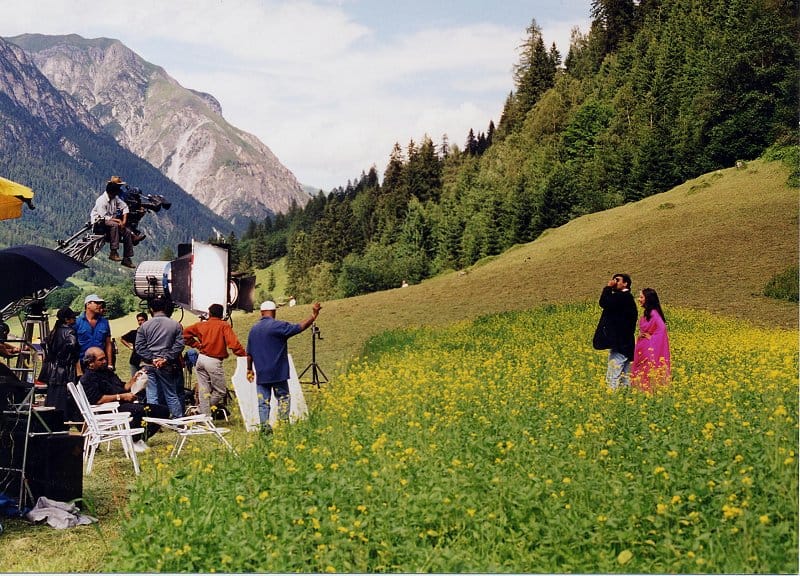
For many years, the stunning mountain landscapes of Tyrol have served as a popular backdrop for Bollywood films. More than 90 Indian film productions have been shot in Austria’s “Land in the Mountains,” introducing millions of viewers to its picturesque Alpine scenery and crystal-clear mountain lakes. Since 1998, Cine Tirol, an initiative of the State of Tyrol and Tirol Werbung, has actively promoted the region as a film location. This strategy has successfully attracted the Indian film industry while simultaneously increasing Tyrol’s popularity as a travel destination for Indian tourists. Bollywood has also made its mark in Vienna, Salzburg, and the Salzkammergut region. For example, the action film Tiger 3 was filmed at all three locations with a production crew of up to 350 people. The Indian film industry also played a role during the Austrian delegation’s visit to India in April 2026. During the trip, Austrian Minister for Economic Affairs Wolfgang Hattmannsdorfer signed a co-production agreement intended to make Austria even more attractive and accessible to one of the world’s largest film markets.
Rabindranath Tagore and Moriz Winternitz
The Indian polymath and first Asian Nobel Prize laureate in Literature, Rabindranath Tagore, visited Vienna in 1926 during one of his nine world tours. During his stay, he met with Sigmund Freud and Stefan Zweig for discussions and exchanges of ideas. A portrait photograph of Tagore taken during this visit by Franz Löwy is now part of the Albertina collection. The Museum Moderner Kunst Stiftung Ludwig Wien (mumok) also houses a large-scale artwork entitled Pawn Rabindranath Tagore (2021). Tagore also maintained a close scholarly relationship with Austrian Indologist Moriz Winternitz. In 1922–23, Winternitz served as a visiting professor at Tagore’s Visva-Bharati University in Santiniketan. He later published the influential monograph Rabindranath Tagore – The Poet’s Religion and Worldview. Winternitz is considered one of the most important Western scholars of Indian studies, and his three-volume History of Indian Literature remains a standard reference work to this day.
TU Austria – Building Future Partnerships with India
In June of last year, TU Austria introduced a new cooperation model with India aimed at establishing collaboration far beyond traditional university partnerships. In addition to agreements between leading Indian technical institutes and TU Austria, strategic alliances at the governmental level were identified as a key objective. As part of this initiative, the first India Science Day 2026 was held in March 2026 at TU Vienna, bringing together 160 researchers, innovators, and students from Austrian and Indian institutions to deepen scientific dialogue between the two countries. TU Vienna has already concluded agreements with IIT Bombay, IIT Madras, IIT (BHU) Varanasi, IIT Kanpur, and the Indian Institute of Science (IISc) Bangalore.
The Austrian-Indian Society
Since its founding in 1963 by Professor Arnold Keyserling and his wife Wilhelmine, the Austrian-Indian Society has served as an important bridge between India and Austria. To mark the Society’s 30th anniversary, India’s then Minister of Industry, Krishna Sahi, traveled to Vienna. Keyserling had developed an early interest in India through his father, the philosopher Hermann Graf Keyserling, and had even met Nobel laureate Rabindranath Tagore, who left a profound impression on him. Together with his wife, Keyserling spent five years in Kolkata and lectured at Tagore’s university, much like Moriz Winternitz before him. After returning to Vienna, he delivered numerous lectures on India before founding the Austrian-Indian Society. The couple brought many distinguished Indian musicians and dancers to Vienna, fostering lively cultural exchange between the two countries. Today, the Society is headed by dancer, choreographer, and educator Professor Dr. Radha Anjali Saber Zaimian.
An Austrian Contribution to a Landmark Tunnel in India
Austria played a significant role in the construction of the Atal Tunnel (also known as the Rohtang Tunnel), which runs at an altitude of more than 3,000 meters and allows year-round access across the previously hazardous Rohtang Pass. The Austrian construction company STRABAG SE, through its wholly owned subsidiary EFKON, contributed expertise based on the New Austrian Tunnelling Method (NATM) to this challenging infrastructure project. At 9.02 kilometers in length and located more than 3,000 meters above sea level, the tunnel is considered an engineering masterpiece. Before its construction, communities beyond the pass were cut off from the outside world for several months each winter. Today, the tunnel reduces travel times by up to six hours. After ten years of construction, the tunnel was officially opened in 2020 and inaugurated by Prime Minister Narendra Modi. STRABAG SE has maintained a continuous presence in India since 1995 and has participated in numerous major infrastructure projects, including the Mumbai Trans Harbour Link and the Delhi Metro.