
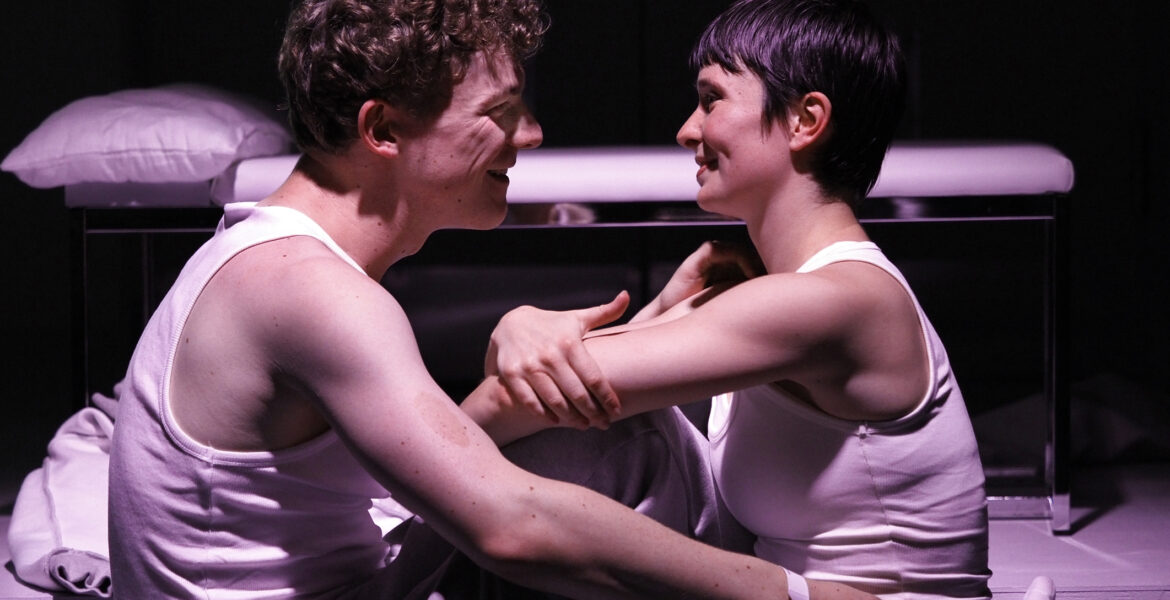
Since 1963, the Vienna’s English Theatre has been Austria’s first English-language theatre. Diplomatic SOCIETY spoke with the management duo Julia and Anna Schafranek about the boards that mean the world.
Director Franz Schafranek and American actress Ruth Brinkmann founded the Vienna’s English Theatre in 1963, originally as a summer theatre for tourists in a small basement venue in Annagasse. However, as it was also very well received by Viennese audiences, it soon began offering a full-year programme and, with the support of the City of Vienna, found its permanent home in Josefsgasse.
After the unexpected death of Franz Schafranek in 1991, his then 23-year-old daughter Julia Schafranek took over the artistic direction of the theatre, with support from her mother Ruth Brinkmann. “I was 23 years old and had just had my first baby. When asked whether I would continue, my answer was: yes, no problem,” Julia Schafranek says in the interview.
At the same time, she admits it was a major challenge: “I wasn’t sure how I would fit into those shoes. How could I reach the standing my parents had in the cultural landscape? That troubled me for many years. One day I woke up and realised that I could not do it like them. I had to trust my own abilities. From that moment on, I knew I would make it.”
After 35 years, another transition is now taking place, as her daughter Anna Schafranek is already actively involved in the company, while Julia Schafranek will continue to play a supportive role. Anna Schafranek first experienced theatre life backstage as a teenager. After ten years in the hospitality industry, she has now returned to the family business.
“The success of our theatre is strongly linked to the selection of plays, and I have always had a good instinct for choosing productions that resonate with our audience. As our unique selling point is being an English-language theatre, it is particularly important that the five productions we present each season offer a certain range. We therefore ensure that there is something classic, such as Shakespeare, but also Oscar Wilde or George Bernard Shaw. Our audience also loves classic British crime stories such as Agatha Christie or the Sherlock Holmes plays by Sir Arthur Conan Doyle. A contemporary, relevant piece is also part of our repertoire. It is no coincidence that we have over 4,000 subscribers. I am convinced that Anna will do a great job,” says Julia Schafranek with pride and full confidence.
“Don’t change a winning team” is also the motto of Anna Schafranek when asked how she envisions leading the Vienna English Theatre. She adds: “We are especially proud of the long-standing loyalty of our subscribers and of continually attracting new audiences.”
Success comes through teamwork, as Anna and Julia Schafranek emphasise: “It is important for us to highlight what our staff across all areas of the theatre achieve every day. With great commitment and high professionalism, they ensure that we are able to offer our audience productions of the highest standard – despite the ever-increasing financial challenges,” says the management duo.
For several years, it has been possible to become a member of the Brinkmann-Schafranek Foundation of Performing Arts, founded by Julia Schafranek in memory of her parents. “We offer our members events such as play introductions, cultural excursions and museum visits, sometimes accompanied by our actors. Depending on membership status, they also receive certain advance booking privileges,” explains the artistic director.
She is also particularly proud of the English-language theatre school “Showtime,” founded in 2010, which teaches children and young people aged three to nineteen the basics of acting, dance and singing, with final performances taking place on the stage of the Vienna English Theatre. “It is always wonderful to see how children gain confidence through training, completely without the performance pressure they experience at school,” says Julia Schafranek proudly. Many Showtime graduates have gone on to perform on the stage of the Vienna’s English Theatre and other theatres.
When asked how she imagines the future of the Vienna’s English Theatre, Anna Schafranek replies: “I hope that we will still exist in a hundred years. I would also wish for theatre to continue to hold a high cultural status. Its live character in particular will become increasingly relevant even for young people, who live so much in the digital world. I hope that people will increasingly return to theatre, as it represents something tangible and alive.”