
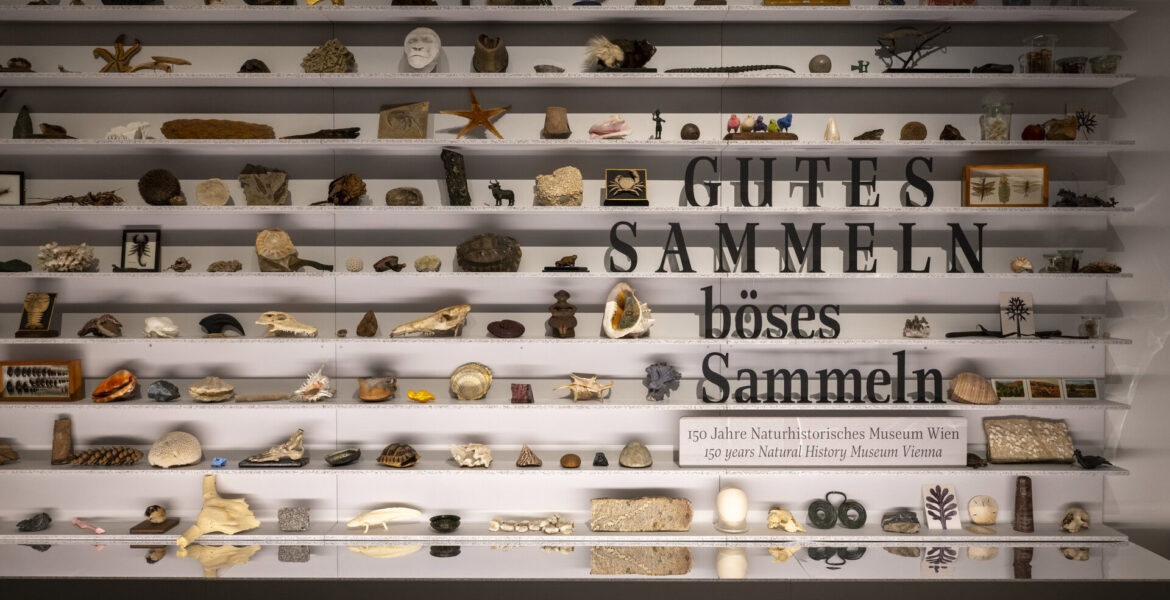
In 2026, the Natural History Museum Vienna (NHM Vienna) takes a critical look back at 150 years of collecting history. Diplomatic SOCIETY spoke with the Director General of the Natural History Museum Vienna, Dr. Katrin Vohland, about the innovative examination of collecting practices, “collecting today,” making research visible, and international exchange between museums.
This year, the NHM Vienna celebrates its 150th anniversary. On this occasion, the exhibition “Good Collecting – Bad Collecting” was created, which critically reflects on the institution’s own history. What scientific standards guide such exhibitions? What does a “modern” engagement with collections look like?
It is interesting that you put “modern” in quotation marks, because we have thought a lot about that: we consider our exhibition to be very innovative. It is undeniably science-based. But what will people think of it in 10 or 50 years? Over the past decades, ethical and scientific evaluations of collecting practices have shifted. While the 18th century was strongly shaped by exploration expeditions and the realization of how vast and diverse the world is, in recent years terms such as “cultural appropriation” have become central to the debate.
Our communication-oriented approach is to show the diversity of perspectives on collection objects and to offer visitors different viewpoints so they can form their own judgement.
In the first room, we present the richness of various objects and their stories. There is also a somewhat playful approach; the “type bar” resembles a pub bar, especially since the glass containers actually contain alcohol. However, the term also refers to “type,” meaning those objects that are inseparably linked to the name of a particular species.
In the second room, discussions such as the value of an object can be explored in greater depth. Two people with very different backgrounds engage in dialogue on this topic.
In addition, there is much to discover in the cabinets, where visitors are invited to reflect on the future of collections.
How can we understand “collecting” today?
We have different disciplines in the museum, and each collects in a different way. Mineralogists know locations where special rocks reach the Earth’s surface and regularly visit them. Meteorite researchers set out after sightings of shooting stars and search the area for fragments. Zoologists still collect animals in the field, although far fewer than in the past. Often, photographs and DNA or tissue samples are sufficient; these represent our newest type of collection object.
Archaeologists and anthropologists also work in the field. We are involved in prehistoric excavations at various sites; the best known is Hallstatt, where we maintain a location together with the Archaeological Centre.
Many activities are supported by volunteers and citizen scientists. The largest growth in our collections currently comes through donations.
The NHM houses more than 30 million objects – which pieces are, in your view, the most “problematic,” and is there an object that particularly fascinates you?
The term “problematic” addresses different levels in my view. It can be problematic if conservation conditions for long-term preservation are not met. Moisture, mould, and museum pests are major challenges that require significant effort to control.
In current discourse, however, “problematic” mainly refers to provenance. On the one hand, there are objects that entered the museum as part of European colonial expansion; on the other hand, there are objects that victims of the Nazi regime had to transfer to the institution free of charge or at very low prices. Today, they serve as starting points for reflection and as a way to counteract contemporary mechanisms of exclusion and devaluation.
One particularly remarkable object, in my view, is the Venus of Willendorf. It illustrates the breadth of scientific disciplines within the museum: from mineralogy of the stone (an oolite), to geology regarding the small shells contained within it, to prehistory, which places this small Stone Age figurine in its cultural-historical context. It also serves as a reference point for contemporary debates, for example on gender roles.
As a trained biologist and Director of the Natural History Museum, how do you view climate change? How do you address it in your role as Director General and scientific director of the NHM?
For me, the topic of climate change is about conveying a fundamental understanding of the underlying physical processes and clearly distinguishing where we are speaking about scientific findings on causes and effects, and where societal negotiation processes begin – for example, who bears the burden of mitigation or adaptation.
One example: a key factor in climate change is land use. Soils are the habitat of plants, fungi, and animals. Soils regulate the water balance, and peat soils in particular store large amounts of carbon. When soil is sealed, these functions can no longer be fulfilled; there is less biodiversity, more flooding, and hotter surfaces. All of this is scientifically measurable, and we communicate such information.
In summary: we provide information on scientific foundations, and we offer space for societal discourse and for negotiating the relationship between humans, nature, and culture through various events.
You have been Director General of the NHM since 2020 – how do you look back on this period, and what are your plans for the future? Have you been able to achieve your goals, such as making research more visible and advancing digitalisation?
When I started at the NHM in 2020, the exhibition halls were empty due to the COVID-19 crisis – a very unusual atmosphere. Now people have returned and fill the museum with life. And yes, we are all working hard to make research more visible: in exhibitions, in the ongoing scientific and educational renewal of the zoological halls, and also in the presentation of plants.
In addition to many lectures and guided tours, there are increasingly behind-the-scenes tours and formats such as “Meet a Scientist,” in order to make the research process more visible.
We have also made progress in the digital field. We are in the process of establishing a unified collection database for our approximately 30 million objects. Through the Austria-wide OSCA consortium (Open Scientific Collections Austria), we are participating in a European research infrastructure, and the Kulturpool not only enables the search for digitally available cultural heritage in Austrian institutions, but also serves as a competence centre and space for reflection on digitisation.
How does the NHM collaborate with other international museums? Do you also have points of contact with diplomacy?
We are in close exchange particularly with other natural history museums in Europe. CETAF (Consortium of European Taxonomic Facilities) is a key network where strategic positioning of museums in light of geopolitical and societal changes is discussed, and which also serves as a professional platform for a wide range of museum topics, sometimes leading to concrete research projects. A relatively new research field is, for example, museomics, where we recently hosted an international conference.
Directly or via ICOM Austria, we also contribute to international debates, for example on the ethical handling of objects of different provenance.
In this area, we also have the most points of contact with diplomacy: for instance, when human remains are repatriated, embassies are involved in planning the ceremonies.
Personally, I also appreciate the concept of science diplomacy, as the global scientific community fundamentally shares a common interest in knowledge. However, science must not – and cannot – be instrumentalised for political agendas.