
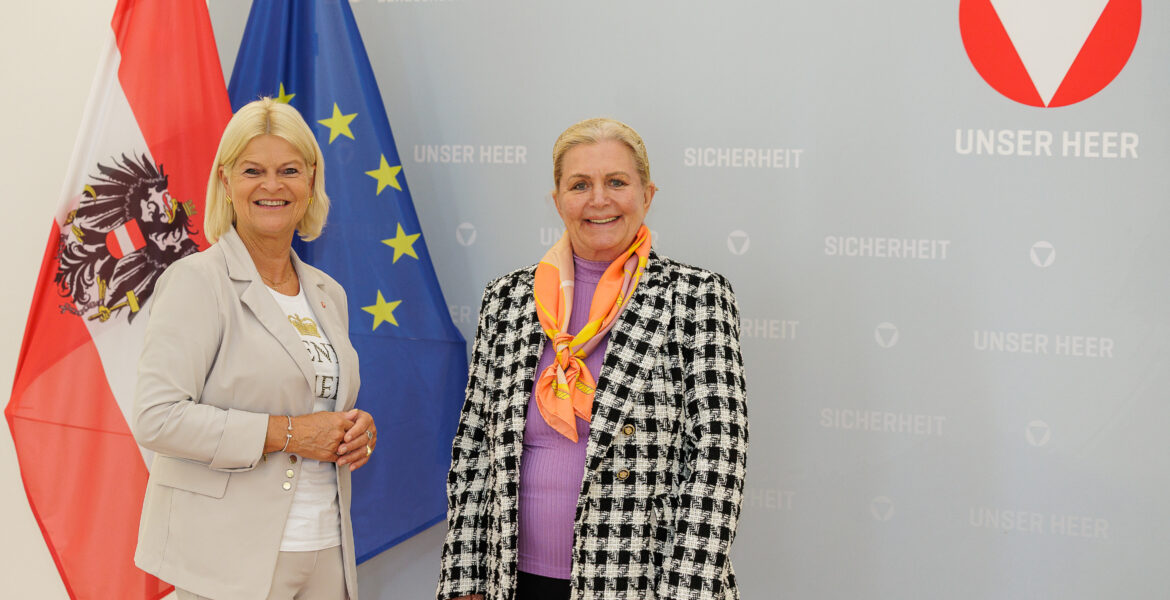
Diplomatic SOCIETY Magazine spoke with Austrian Federal Minister for Defence, Klaudia Tanner, in September 2026 about the new security environment, military service reforms, international military cooperation and women in the Austrian Armed Forces.
In July, the federal government agreed on a comprehensive military service reform, the key elements of which are the new “6 plus 3” month model and a monthly military service allowance of around €1,000 net. Since the FPÖ and the Greens do not support this package, how do you intend to secure the two-thirds majority required in Parliament?
The geopolitical and security situation has changed significantly. Even a neutral country such as Austria must respond to these changes. This is not just about rearmament and the budgetary situation; it is also very much about whether we have sufficient personnel. Support for conscription remains consistently high at 73 percent. Against this backdrop, we also initiated the discussion about extending basic military service.
For years, as part of “Mission Forward”, we have been focusing intensively on the procurement and modernisation of the Austrian Armed Forces. But we now also need well-trained personnel who can make use of these capabilities and who are actually ready for deployment when required. Learn, practise, consolidate – these are the three basic principles of military service. Only those who train regularly remain operationally ready.
That is why extending military service is a necessity. It is about the overall defensive capability of our society and, of course, the operational readiness of the Austrian Armed Forces. With six months of basic military service, there is simply not enough time for comprehensive training and regular exercises. In future, basic military service – meaning the core service period including exercises – will total nine months. We took this decision jointly in the federal government at the Council of Ministers. This will substantially improve the training of our conscripts while simultaneously increasing the operational readiness of the Austrian Armed Forces.
The immediate task now is to put the necessary framework in place. We will begin all necessary preparations immediately so that the new model can be implemented as quickly as possible. This reform is not an end in itself; it is a response to the changed security environment. Negotiations are currently under way at the operational level, alongside informal discussions with the opposition parties. These talks focus in particular on the specific design of the three additional months, but also on a comprehensive package of accompanying measures. I view these discussions positively and am convinced that we can also persuade the opposition parties that this is a necessary decision for Austria’s security. Party politics must not be placed above the security of our country.
The federal government’s objective is for the new regulation to enter into force on 1 January 2027. Given the parliamentary negotiations that are still pending and the opposition’s firm stance, is this timetable not rather difficult to achieve?
The security situation does not take account of lengthy decision-making processes. That is why the reform must and will be implemented promptly. As mentioned at the outset, two main areas are currently being worked out. The first concerns the specific structure of the total nine months of military service and how this period needs to be divided – in other words, how long the core service, troop training and militia exercises should each last.
The second concerns the automatic mechanism for civilian service. If the number of conscripts falls below a certain threshold, civilian service will automatically be extended. This element is also scheduled to enter into force on 1 January 2027. These issues therefore need to be substantively negotiated and finalised in the coming weeks so that the necessary legislative deadlines can also be met.
The accompanying measures, by contrast, are not subject to the same time pressure. Not every individual measure has to enter into force on 1 January 2027. In some cases, other ministries are also responsible, which means that more in-depth discussions are required. For example, several ministries are involved when we talk about the planned annual large-scale exercise or about converting medical examination centres into health centres.
The key driving force behind this reform is the changed security environment. That is why it is essential for us to make it possible for the new rules to enter into force on 1 January 2027. Defence capability requires good training, and good training requires sufficient time as well as regular exercises to ensure that the skills acquired are maintained. We are therefore working intensively on implementation and are confident that the negotiation process will produce a result in time.
Critics fear that aligning the periods of service could harm the Austrian Armed Forces. Do you think the new model could trigger a massive shift towards civilian service, ultimately leaving the military without the necessary number of conscripts?
Naturally, we are concerned about these possible developments, particularly because we are already seeing an increasing number of applications for civilian service. That is why we have also agreed to increase the allowance for conscripts from around €600 to €1,000 in future.
In addition, we have adopted a “Military Service Guarantee”. It establishes a clear automatic mechanism: if the number of conscripts falls below 15,000, the Military Service Guarantee will take effect. From the following year onwards, civilian service will then be extended by two months. This will ensure that the Austrian Armed Forces continue to have the necessary number of conscripts while maintaining a balanced relationship between military and civilian service.
Europe is currently experiencing a collective military build-up. How does neutral Austria position itself in this context?
Europe’s security environment has changed significantly as a result of geopolitical and security developments in recent years. International conflicts between nation states are increasing, both politically and economically. The war in Ukraine and developments relating to the conflict involving Iran demonstrate that we are living in a period in which Austria, too, must reassess its security situation and prepare accordingly.
We recognised this development at an early stage and drew the necessary conclusions. That is why we will continue to invest in the protection and security of our country in the coming years. Our “Mission Forward” is therefore also a “Mission Upward”: we are continuously increasing our defence budget, thereby creating the foundation for the capabilities the Austrian Armed Forces need. “Mission Forward” and the Defence Development Plan 2032+ are the central foundations for this. The operational objective is for the Austrian Armed Forces to be fully capable of defending the country by 2032. Particularly in view of new threats posed by drones and other means of attack, this means that we need to expand our air-defence capabilities. “Skyshield” and the Eurofighters are not ends in themselves; they are a necessity.
As a neutral country in particular, we must be aware that neutrality does not protect Austria by itself. We must be capable of protecting our neutrality. Everyone must be aware that protection, security, peace and freedom cannot be taken for granted and are not simply given to us.
At the same time, we can see that the European Union also wants to significantly strengthen its defence capabilities. This includes investing more quickly and cost-effectively in military capabilities and making greater joint use of European capacities. With its White Paper, European Defence Readiness 2030, the EU has set corresponding objectives.
For us, it is clear that defence must be understood in comprehensive terms. That is why we have also dealt intensively with Comprehensive National Defence. It consists of civilian, economic and intellectual defence, followed only at the final stage by military defence. An important area here is intellectual defence. We need to create greater awareness again of what it means to protect our democracy, our freedom and our sovereignty. We are doing this by strengthening the activities of our information officers in schools and businesses.
In an interconnected world, security diplomacy is becoming increasingly important. How do you maintain your international contacts at the diplomatic level, and what strategic role do multilateral military cooperation projects play in this context?
In a tense geopolitical environment, a strong international network is indispensable. This applies to the political level just as much as it does to the Austrian Armed Forces. Our defence attachés are stationed around the world and serve as the eyes and ears of the Austrian Armed Forces abroad. They make an indispensable contribution to international cooperation and therefore also to Austria’s security.
Through their well-founded assessments, they provide an important basis for our security-policy decisions and support the Austrian Armed Forces in their diverse tasks at home and abroad. Particularly in the face of rapidly changing international developments, it is crucial to identify changes at an early stage while keeping communication channels with our international partners open. This also applies to our intelligence services, which need to be well connected internationally so that potential threats can be identified as early as possible. That is why we have been calling for years for an expansion of the Military Powers Act in order to further develop the relevant capabilities.
At EU level, I regularly exchange views with my European counterparts as part of meetings of defence ministers. In addition, bilateral discussions and meetings with international partners are an important part of my work. Multinational cooperation is also highly important for the Austrian Armed Forces. This begins with joint training programmes, for example with Switzerland or Germany, and extends to the exchange of specific capabilities. One example is the exchange of air situation pictures or the joint monitoring of airspace, as we most recently did at individual events in Switzerland as part of DÄDALUS26.
Another important area is joint procurement and the joint acquisition of capabilities. For example, there are cooperation projects with the Netherlands involving Embraer transport aircraft, and with Luxembourg concerning the acquisition of satellite communications capabilities. Such cooperation strengthens our own capabilities while also allowing resources to be used more efficiently.
Promoting women in military service is a particular personal priority for you. You have already made a significant contribution to strengthening the role of women in the Austrian Armed Forces. What key achievements have you made so far?
Promoting women in the Austrian Armed Forces is a very important personal priority for me. In 2023, we introduced voluntary basic military service for women in the Austrian Armed Forces, thereby taking an important step forward. Since then, we have been able to significantly increase the proportion of female soldiers. We currently have 864 female soldiers, which is double the number we had a few years ago.
By continuously promoting women in leadership positions and consistently implementing equality measures, the Austrian Armed Forces are setting clear standards for a modern and future-oriented military. Equal opportunities must apply at every level – from military leadership positions to civilian management roles. Women and men should have the same opportunities and receive the same pay for equal performance. Leadership ability must not be a question of gender.
That is why we have established mentoring programmes for female soldiers and civilian employees. This year, we also launched a dedicated programme for future leaders, which was conducted in three modules. In addition to training and professional qualifications, networking also plays an important role. In this particular area, we can partly learn from what men have traditionally made greater use of.
I want every woman in the Austrian Armed Forces to have the same opportunities and chances to pursue her career, and of course the pay is completely equal as well. A visible sign of the progress we are making was, for me, the promotion of the first woman in the General Staff to the rank of brigadier. That had not happened for a very long time.
And my personal wish for the future is clear: when we have a new Chief of the General Staff in a few years’ time, I would like to see a woman ready to apply for this position as well. For me, that would be another sign that women in the Austrian Armed Forces truly have every career path open to them.