

Diplomatic SOCIETY spoke with H.E. Pattarat Hongtong, Ambassador of the Kingdom of Thailand to Austria, about bilateral relations, Thailand’s foreign policy and its process to join the OECD.
Thailand’s and Austria’s ties date back to the year 1869. What, in your opinion, were the most outstanding milestones throughout these 156 years? What makes the relations between Austria and Thailand special?
The relations between Thailand and Austria is enduring friendship, built over more than 150 years on a strong foundation of mutual respect, shared values, and deep commitment to cooperation. Our diplomatic ties officially began with the signing of the Treaty of Friendship, Commerce and Navigation in 1869, during the reign of King Chulalongkorn and Emperor Franz Joseph I. This historic agreement was not only a diplomatic milestone, but also reflected Thailand’s openness to international partnerships, and then Austria has become one of our earliest partners in the region.
Throughout our century-long relations, several landmarks have stood out.
First, the steady and cordial ties strengthened through the exchanges of high-level visits. Since the era of Siam, the former name of Thailand, and Austria-Hungary, several royal visits took place including those of Archduke Leopold Ferdinand of Austria in 1888, King Chulalongkorn or King Rama V of Siam in 1897, and the state visit of Their Majesties King Bhumibol Adulyadej and Queen Sirikit in 1964, followed by visits from other members of the Royal Thai Family, including King Rama X when he was Crown Prince Vajiralongkorn. Austria also paid official visits to Thailand, notably by Federal President Franz Jonas in 1967 and Federal President Thomas Klestil in 1995. The most significant chapter in our bilateral history emerged during the tenure of Her Royal Highness Princess Bajrakitiyabha Narendiradebyavati as Thailand’s Ambassador to Austria in 2012-2014. Under her leadership, our relations were greatly elevated, especially in the multilateral sphere through her active engagement in Vienna- based international organizations.
Second, at the heart of Thai-Austrian relations is a strong people-to-people connection. Austria is currently home to about 5,000 Thai nationals, including many students, who further connect our two peoples through cultures such as cuisine and music. While these cultural exchanges continue to enrich mutual understanding, tourism remains a pillar of contact, with hundreds of thousands of Austrians experiencing Thailand’s cultural and natural diversity each year. These interactions have also fostered meaningful cooperation in creative economy such as gastronomy, fashion, spa and wellness, and film. Academic collaboration is another key dimension of our people-centered partnership, exemplified by Thai participation in ASEA- UNINET, which has long supported exchanges in higher education and research between Thai and Austrian universities.
Third, bilateral cooperation extends to a wide range of economic sectors, including trade, investment, education, innovation, SME, sustainable agriculture, and tourism. Austrian expertise in environmentally friendly technology complements Thailand’s ambition to transition toward a low-carbon economy. Potential areas for Austrian investment include infrastructure, bio-circular technologies, and renewable energy. Today, more than 100 Austrian companies operate Thailand, making Austria the third-largest EU investor in the country. In terms of trade, the total goods trade volume between Austria and Thailand reached approximately €600 million in 2024, with Thailand importing from Austria around €400 million and exporting to Austria around €200 million. At the same time, Thailand’s excellent logistics infrastructure, regional connectivity, the Eastern Economic Corridor (EEC) initiative, and the promising of Thailand- EU FTA continue to attract Austrian businesses seeking entry into the dynamic ASEAN market.
In essence, Thailand’s foreign policy is not about choosing sides, but about choosing peace, cooperation, and progress.

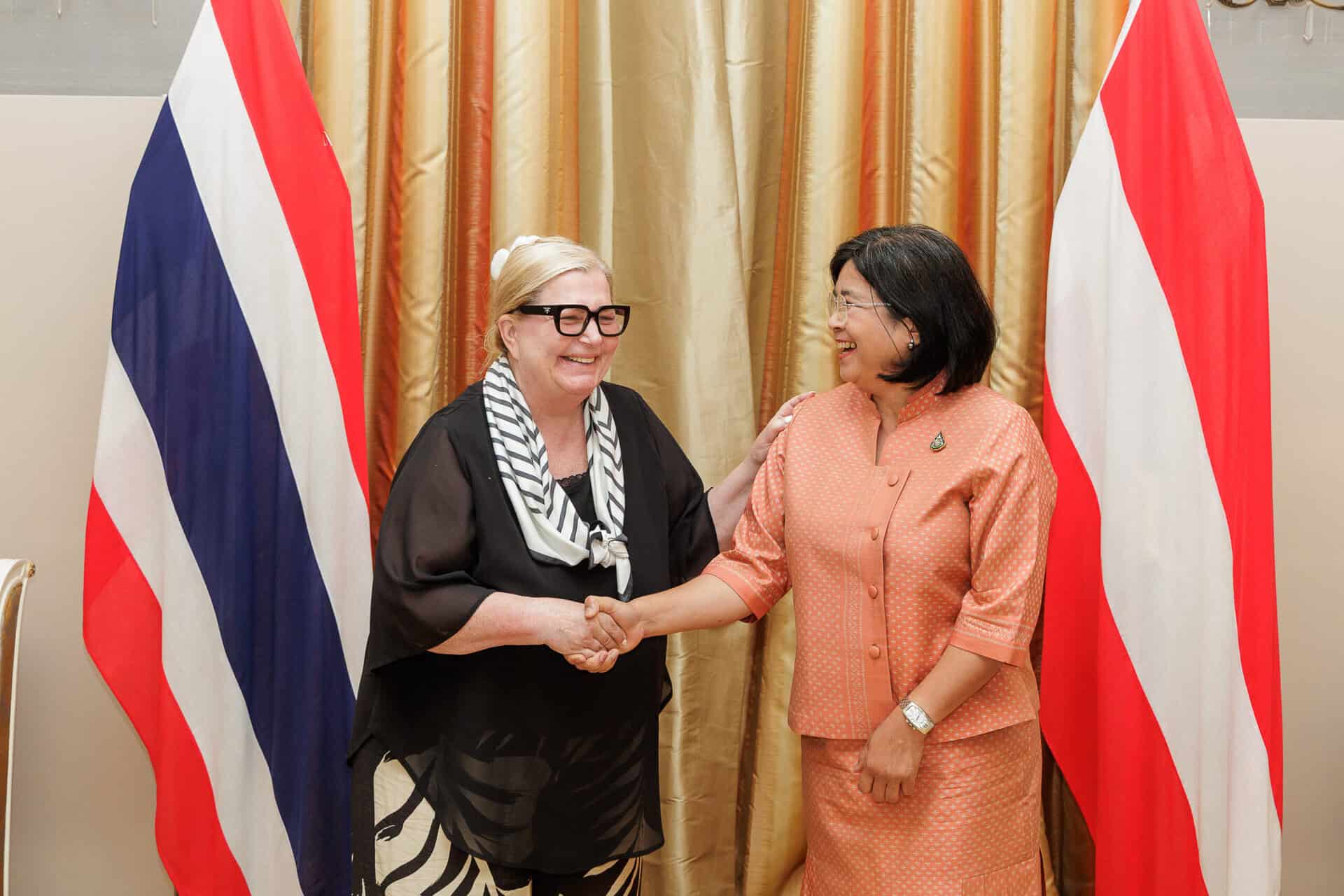


Fourth, the partnership of trust and cooperation between Thailand and Austria extends beyond the bilateral sphere into regional and multilateral frameworks. In the context of geopolitical and global economic challenges, our two countries share common value and support for international efforts varies from sustainable development, women empowerment, gender equality, cyber security to peacebuilding, disarmament and nuclear non-proliferation. Beyond cooperation within the EU and OSCE, Thailand stands ready to serve as a bridge connecting Austria with Southeast Asian region and ASEAN, including supporting Austria’s accession to the Treaty of Amity and Cooperation in Southeast Asia (TAC).
As both nations look ahead, the solid foundation of trust built over 150 years ensures that Thailand and Austria will continue to grow together as partners for peace, sustainability, and shared prosperity.
You are accredited as Thailand’s Ambassador in Austria since March 2025 – how did you prepare yourself for this posting? What were the things/mannerisms that surprised you the most when moving here?
The journey to becoming an Ambassador is an accumulation of experiences that began with the moment I joined the diplomatic service as a junior officer. Every level of work and every posting have provided me invaluable lessons. I have learned extensively from my predecessors and superiors, observing how successful Ambassadors lead and manage a mission as well as roles of their spouses. This forging process has also been influenced by engagement with the diplomatic community, consular services, and Thai communities overseas.
I also dedicated significant time to immersing myself in the current context of Austria—its political, economic, and social landscape—drawing information from many sources. I found it essential to connect with people who have direct experience in the country, including former Thai and Austria diplomats. I also engaged closely with various Thai public and private sector stakeholders to identify mutual interests and opportunities, such as expanding trade, investment, and exploring economic, human resources and cultural collaboration. This involved concrete discussions with groups interested in the potential for enhanced cooperation in areas like education and culture, ensuring the embassy’s agenda is fully aligned with the priorities of both Thailand and Austria and serves the interests of the country.
Thailand’s OECD accession creates strong opportunities, particulary with Austria
Regarding the surprises that have stood out the most since moving here, two observations immediately come to mind. First, I was deeply struck by the seamless integration of deep historical preservation with modern efficiency. Vienna is the beautiful capital of classical culture, yet the sophistication and advancement of the public infrastructure, public services, and green and environmental technology is exemplary. Secondly, in terms of mannerisms, I appreciate the friendly and openness style of Austrians, which I found helpful in building strong working relationships.
Now to a more “general” topic: What defines Thailand’s foreign policy? And who are Thailand’s key partners?
Thailand’s foreign policy has always been guided by the principles of friendship, balance, and constructive engagement. As a country situated at the heart of Southeast Asia, we see diplomacy not merely as a means of managing relations, but also a vehicle for building trust, fostering cooperation, and delivering tangible benefits to our people.
In today’s complex global landscape marked by geopolitical tensions, technological disruption, and climate change, Thailand has adopted a forward-looking and multi-dimensional foreign policy guided by six key priorities: (1) proactive, people-centered diplomacy that deliver tangible benefits to our citizens; (2) constructive and dynamic foreign policy putting Thailand on the radar screen and shaping global agendas; (3) unified, future-ready, and multi-dimensional diplomacy across political, economic, social, and cultural spheres; (4) results-driven economic diplomacy to open new markets and attract innovation-driven investment; (5) multi-directional foreign policy bridging the powers, affirm a leading role in ASEAN, and looking beyond Thailand; and (6) protection of sovereignty and territorial integrity through peaceful solutions and adherence to international law.
Economic diplomacy has become a central pillar of Thailand’s foreign policy. By deepening existing trade relationships and actively exploring new markets, Thailand aims to position itself as a dynamic player in the global economy. Strengthening the partnership with Austria and the European Union (EU) is one of the top priorities. Austria offers significant opportunities for increased trade, investment, and technology cooperation. Meanwhile, Thailand’s ongoing Free Trade Agreement (FTA) negotiation with the EU marks a milestone that will further enhance our trade and investment. At the same time, Thailand is pursuing membership in the Organization for Economic Co-operation and Development (OECD) strengthening its position as a reliable and responsible global economic partner.
Thailand remains a steadfast advocate for multilateralism and the rule of law. As a founding member of ASEAN, Thailand continues to promote unity and centrality within the region taking an active role in addressing shared challenges, including the situation in Myanmar and cross- border disputes. At the same time, we maintain dynamic and growing partnerships with countries across Asia, Europe, the Americas, and beyond.
At the multilateral level, Thailand continues to play an active role within the United Nations system contributing to peacekeeping, humanitarian assistance, global health, and climate action. In all these endeavors, we strive to be a bridge-builder connecting regions, promoting dialogue, and reinforcing the international rules-based order.
In essence, Thailand’s foreign policy is not about choosing sides, but about choosing peace, cooperation, and progress. We remain committed to working with all partners to strengthen the fabric of international partnership and to build a more stable, prosperous, and inclusive world.
In 2024, the OECD launched the accession process with Thailand – what is the current status of this process and why is it important for Thailand to be part of this Organization?
Thailand’s accession to the OECD is a national priority. It receives broad-based support from all stakeholders, especially the private sector. It enjoys a non-partisan support, as all successive Thai governments, including the current one, remain determined to driving it towards its successful conclusion.
For Thailand, the accession process is a transformative journey that will help Thailand achieving the target of becoming a high-income economy by 2037. It will strengthen innovative, resilient and sustainable economic growth, and efficient public administration, by supporting Thailand adopting high international best practices.
The accession process has started in June 2024 as the OECD Council decided to open the Accession Discussions with Thailand. The Accession Discussions has progressed very satisfactorily. Currently, Thai agencies are preparing the Initial Memorandum, which is the self- assessment of Thai legal frameworks, policies and practices against all 270 OECD instruments. We aim to handover this initial memorandum by the end of 2025 at the third official visit of the OECD Secretary-General to Bangkok in December this year.
After that, we will enter the technical review phase, during which Thailand, in close and intensive cooperation with the OECD and its members, will to gradually adjust legal frameworks, policies and practices in line with OECD standards. Our target is to become a member country by 2030.
Thailand’s OECD accession creates strong opportunities, particularly with Austria. Aligning with OECD standards enhances Thailand’s market competitiveness, attracting high-quality investment and reinforcing its place in sustainable global supply chains. The move also facilitates reciprocal investment into OECD countries, contributing to growth and employment in OECD members as well.