

Diplomatic SOCIETY spoke with H.E. Hisham Al Alawi about his key objectives as Ambassador of Iraq to Austria, connecting lines between his country and Austria, and Iraq’s path to reconstruction and recovery.
You recently started your term as Ambassador of Iraq to Austria and you will also be the Permanent Representative to the UN and other International Organizations in Vienna. Can you tell us a little bit about your key objectives for your term?
It is a great honour to represent the Republic of Iraq in Austria, a country with a distinguished diplomatic tradition and the host of many of the world’s most important International Organizations. Vienna is not only Austria’s capital; it is also one of the principal centres of multilateral diplomacy, making this assignment particularly significant.
My foremost objective is to elevate Iraqi-Austrian relations to a more comprehensive strategic partnership. While our bilateral relations are friendly and based on mutual respect, I believe there remains considerable untapped potential in areas such as trade and investment, energy/renewable energy, infrastructure, higher education & scientific research, healthcare, smart agriculture & water management, tourism, culture, and vocational training.
At the multilateral level, Iraq attaches great importance to its cooperation with the UN and the International Organizations headquartered in Vienna. These institutions play an essential role in promoting international peace, nuclear safety and security, sustainable development, industrial development, and international cooperation.
Another important priority is strengthening people-to-people ties. The large Iraqi community in Austria, together with Austrian friends of Iraq, can play a valuable role in building bridges.
Ultimately, my mission is to present a positive contemporary image of Iraq – a country with one of the world’s oldest civilizations, abundant natural resources and skilled human resources – that is confidently looking toward the future.

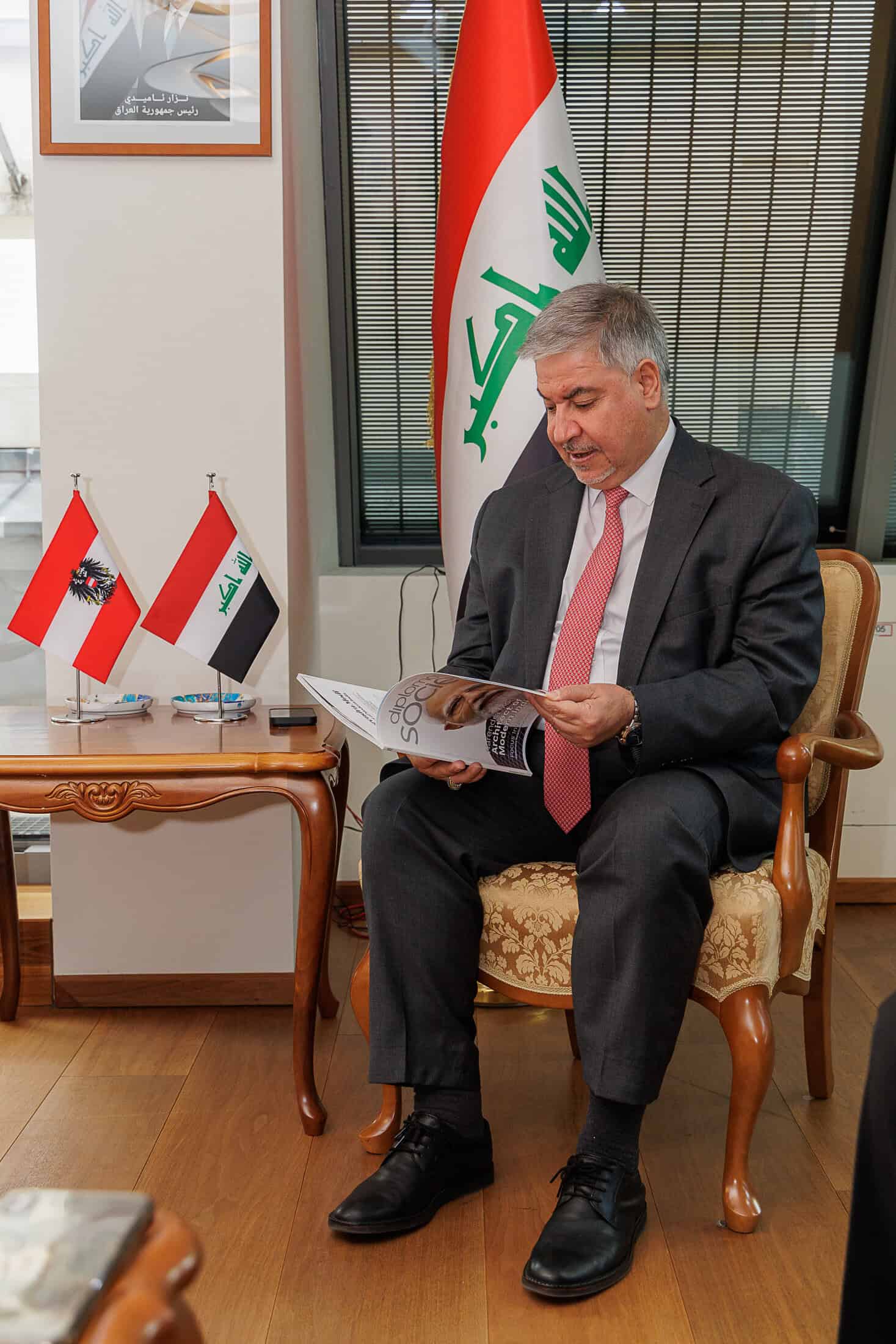
What are the most interesting and maybe surprising connecting lines between Austria and Iraq? In which sectors do you see the greatest potential for cooperation?
Although geographically distant, Iraq and Austria share a longer history of interaction than many people realize.
Austria has long been recognised as a meeting place for international dialogue, while Iraq has historically served as a crossroads of civilizations connecting East and West. Both countries value cultural heritage, education, and international cooperation.
Austria has earned an outstanding global reputation in engineering, environmental technologies, renewable energy, healthcare, vocational education, transport infrastructure, and advanced manufacturing. Iraq, meanwhile, is implementing ambitious development and economic diversification programmes that create significant opportunities for Austrian expertise and investment.
I see particularly promising opportunities in renewable energy, water resource management, smart agriculture, waste management, railway and transport infrastructure, healthcare modernization, digital transformation, industrial development, higher education partnerships, archaeological preservation, and tourism.
There is also significant potential to strengthen cooperation through Austrian participation in Iraq’s major development projects, and by encouraging greater engagement between chambers of commerce, universities, research institutions, and cultural organizations.
Economic diplomacy will therefore be one of the central pillars of my mission.
How do you intend to engage with the Iraqi diaspora in Austria?
The Iraqi communities around the world represent one of Iraq’s greatest assets abroad.
Many Iraqis living in Austria have become successful professionals, academics, entrepreneurs, engineers, physicians, artists, and students. They contribute positively to Austrian society while maintaining strong emotional and cultural ties with their homeland.
Our Embassy seeks to be an open, accessible, and service-oriented institution. We intend to strengthen communication with all members of the Iraqi community through regular dialogue, cultural events, educational initiatives, youth engagement, and improved consular services.
At the same time, we hope to encourage members of the diaspora to contribute their expertise, knowledge, investment, and professional networks to Iraq’s ongoing development. Their experience in Austria provides valuable bridges between our two countries.
The Embassy also wishes to deepen cooperation with Austrian institutions that support intercultural dialogue and integration, thereby strengthening mutual understanding between our peoples.
How would you define your own philosophy behind your work as a diplomat? What are the most important skills an Ambassador should bring to the table?
Diplomacy, in my view, is fundamentally about building mutual understanding and trust. Trust cannot be imposed; it is earned through consistency, credibility, respect, and constructive dialogue.
Having served both as a consultant physician and later as a senior diplomat, I have come to appreciate that both professions share a common purpose: understanding problems carefully before attempting to solve them. Diplomacy requires listening as much as speaking, seeking common ground rather than amplifying differences.
An Ambassador today must combine strategic vision with practical problem-solving. Beyond representing national interests, he or she must also be an effective communicator, bridge-builder, a good negotiator, and facilitator of partnerships among governments, International Organizations, academia, business communities, and civil society.
In today’s increasingly complex international environment, diplomacy has become more important than ever. The world faces interconnected challenges that no country can solve alone.
Effective diplomacy allows states to manage differences peacefully, reduce misunderstandings, and create opportunities for cooperation even where disagreements exist. Multilateral institutions remain indispensable because they provide platforms where dialogue can prevail over confrontation, and international law can guide collective action.
For Iraq, diplomacy is a strategic instrument for promoting regional stability, balanced international partnerships, and peaceful coexistence. Iraq seeks to maintain constructive relations with all partners based on mutual respect, sovereignty, non-interference, and shared interests.
Nine years after the end of the war against the terrorist organization (ISIL), what are your country’s major challenges on its path to reconstruction and recovery?
Iraq has made remarkable progress since the military defeat of Da’esh (ISIL). Today, Iraq enjoys significantly improved security and is increasingly focusing its national efforts on achieving sustainable development, economic reform, institutional modernization, and improving the quality of life for its citizens.
Like many countries emerging from conflict, reconstruction is a comprehensive process that extends beyond rebuilding infrastructure. It includes strengthening institutions, creating employment opportunities, diversifying the economy, modernizing public services, enhancing education and healthcare, supporting private-sector growth, and investing in human capital.
The Government of Iraq is pursuing ambitious reforms aimed at promoting sustainable economic growth, improving governance, expanding infrastructure, attracting foreign investment, and strengthening regional connectivity. Major strategic initiatives – including the Development Road Project – reflect Iraq’s aspiration to become an important regional trade and transportation hub connecting Asia, the Middle East, and Europe.
At the same time, Iraq continues to work closely with its international partners and the UN in addressing humanitarian needs, supporting displaced communities, combating terrorism, preventing violent extremism, and promoting inclusive development.
We remain optimistic about Iraq’s future. The country possesses enormous human talent, abundant natural resources, a strategic geographical location, and one of the world’s richest historical and cultural heritages. These strengths provide a solid foundation for long-term stability, prosperity, and constructive engagement with the international community.