
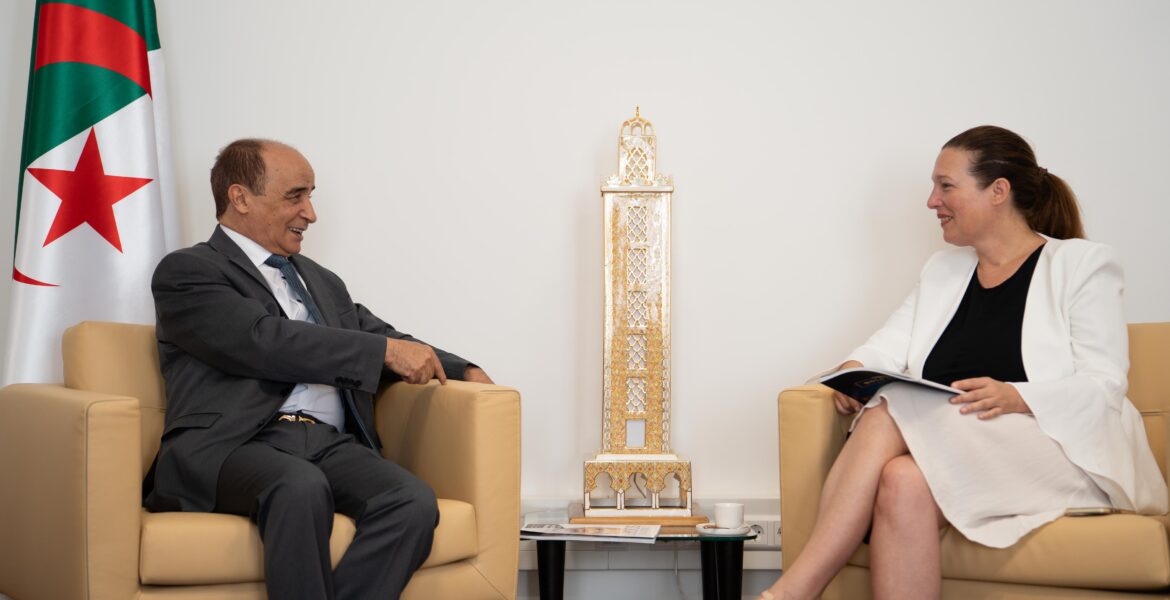
The new Algerian Ambassador to Austria, H.E. Rachid Bladehane, sat down with Diplomatic SOCIETY Magazine to speak about the positive momentum Austrian-Algerian relations are currently experiencing, the principles of his country’s foreign policy and the most important lessons he learned while working as a diplomat.
Within the last years, Austrian-Algerian ties experienced a significant upward trajectory – how would you assess the current diplomatic relations between our two countries? Where are the strongest areas of cooperation and in which fields would you like to see the relationship intensified?
Relations between Algeria and Austria are currently enjoying positive momentum, with both sides demonstrating a consistent willingness to further strengthen them.
This relationship is first and foremost based on a solid political foundation: a convergence of views on major international issues, as well as a shared commitment to the ideals and objectives of the United Nations, particularly international law and the peaceful settlement of conflicts. This political dialogue is structured through regular political consultations.
Contacts between the foreign ministers of the two countries are also frequent. I am thinking in particular of their meeting on the margins of the 80th session of the United Nations General Assembly in September 2025. Their discussions covered the state of bilateral relations, as well as preparations for Austria’s candidacy for the UN Security Council for the 2027–2028 term, which Algeria has supported. In this regard, Algeria has particularly underlined the fact that Austria’s status as a country without a colonial past constitutes an asset in this election.
This political momentum was translated into concrete action during the visit of H.E. Mr. Ahmed Attaf, Minister of State and Minister of Foreign Affairs, to Vienna from 25 to 27 June 2024, when a decision was taken to give new impetus to our cooperation. This includes finalizing several bilateral agreements currently under negotiation and reactivating the Algerian-Austrian Joint Business Council, which is expected to become a genuine driving force for our economic exchanges, supported by more than 500 Austrian companies maintaining regular business relations with Algeria.
The sectors in which our cooperation holds the greatest promise remain renewable energy, agriculture, the railway sector, industry, water resources and pharmaceuticals. The air link between our two capitals, inaugurated in 2014, was reactivated in 2023, and there are now two weekly flights between Algiers and Vienna.
A flagship example of our energy cooperation is the SoutH2Corridor, a green hydrogen corridor bringing together Algeria, Italy, Austria and Germany. It is precisely the kind of major, forward-looking project that supports the energy transition. A dedicated legal instrument on renewable energy, currently being finalized, is also expected to be signed very shortly between our two countries.
Our cooperation is not limited to the economic dimension. Parliamentary diplomacy is also playing an increasingly important role, with two reciprocal visits to Vienna and Algiers in July and October 2023.
Finally, Vienna occupies a particularly unique place within Algeria’s diplomatic network. It is not only the capital of an important bilateral partner; it is also the headquarters of three international organizations whose work directly relates to Algeria’s strategic priorities: the International Atomic Energy Agency (IAEA), the United Nations Office on Drugs and Crime (UNODC), and the Comprehensive Nuclear-Test-Ban Treaty Organization (CTBTO).


Can you tell us about your country’s Foreign Policy? What are its main pillars? And which role is Algeria taking on in the Maghreb region and Africa in general?
Algeria’s foreign policy is based on fundamental principles that have remained unchanged since independence.
The first of these principles is non-alignment.
The second pillar is non-interference in the internal affairs of other states, which is complemented, in turn, by our commitment to the peaceful settlement of disputes through dialogue.
The third is our steadfast support for just causes, which lies at the very heart of our country’s history and its struggle for liberation.
This doctrinal foundation, inherited from 1 November 1954, has adapted to the transformations of the world without ever compromising its core principles.
In the Maghreb, Algeria seeks to be a factor of stability and a steadfast advocate of regional integration. We firmly believe that the future of the peoples of the region lies in cooperation.
At the African level, Algeria has always considered its security and prosperity to be inseparable from those of the continent. It works to promote African solutions to African problems.
We also remain deeply committed to combating terrorism in the Sahel-Saharan region through strengthened regional cooperation.
Algeria’s commitment is also reflected in concrete economic measures and significant initiatives, including the cancellation and/or conversion of debt into investments, as well as the establishment of a USD 1 billion fund to support cooperation with African countries.
Algeria is also advancing major continental projects, such as:
- The Trans-Saharan Gas Pipeline (TSGP), which is intended to link Nigeria, Niger and Algeria over more than 4,000 kilometres, with a transport capacity of 30 billion cubic metres of gas per year, with a view to supplying Europe.
- The Trans-Saharan Highway, linking Algiers to Lagos via Niger, is another major project aimed at promoting the physical integration of the continent.
- The Trans-Saharan Fibre-Optic Backbone, which aims to connect Algeria with Niger, Nigeria, Chad, Mali and Mauritania, thereby helping to digitally open up isolated regions and reduce development disparities across the continent.
In recent years, Algeria experienced a notable tourism surge – which role could or should tourism take on in the economic framework of your country?
Tourism is now clearly identified as a strategic lever for economic diversification, within the framework of a sustainable development model.
The figures demonstrate remarkable momentum. Algeria welcomed more than 3.5 million tourists in 2025, representing significant growth, and has now set itself the ambitious objective of reaching 8 million tourists by 2029.
This strategy is based on the rational development of all the assets Algeria has to offer: coastal and seaside tourism, thalassotherapy, mountain tourism, Saharan tourism, business tourism, as well as cultural and religious tourism.
You are looking back at an impressive diplomatic career – what were the most important lessons you learned? What advice would you give to young diplomats? And how has the profession of a diplomat changed?
The lesson I draw from my own experience is probably one of patience, moderation, sustained effort and listening. The most delicate issues I have dealt with throughout my career have never been resolved in a single meeting; they have been built through small steps forward, through dialogue, and through a constructive search for points of balance between the different interests at stake.
Above all, a diplomat must cultivate the art of genuine listening – the kind of listening that truly seeks to understand the position, constraints and sensitivities of the other party, while remaining faithful to the principles one represents in a rapidly changing world.