

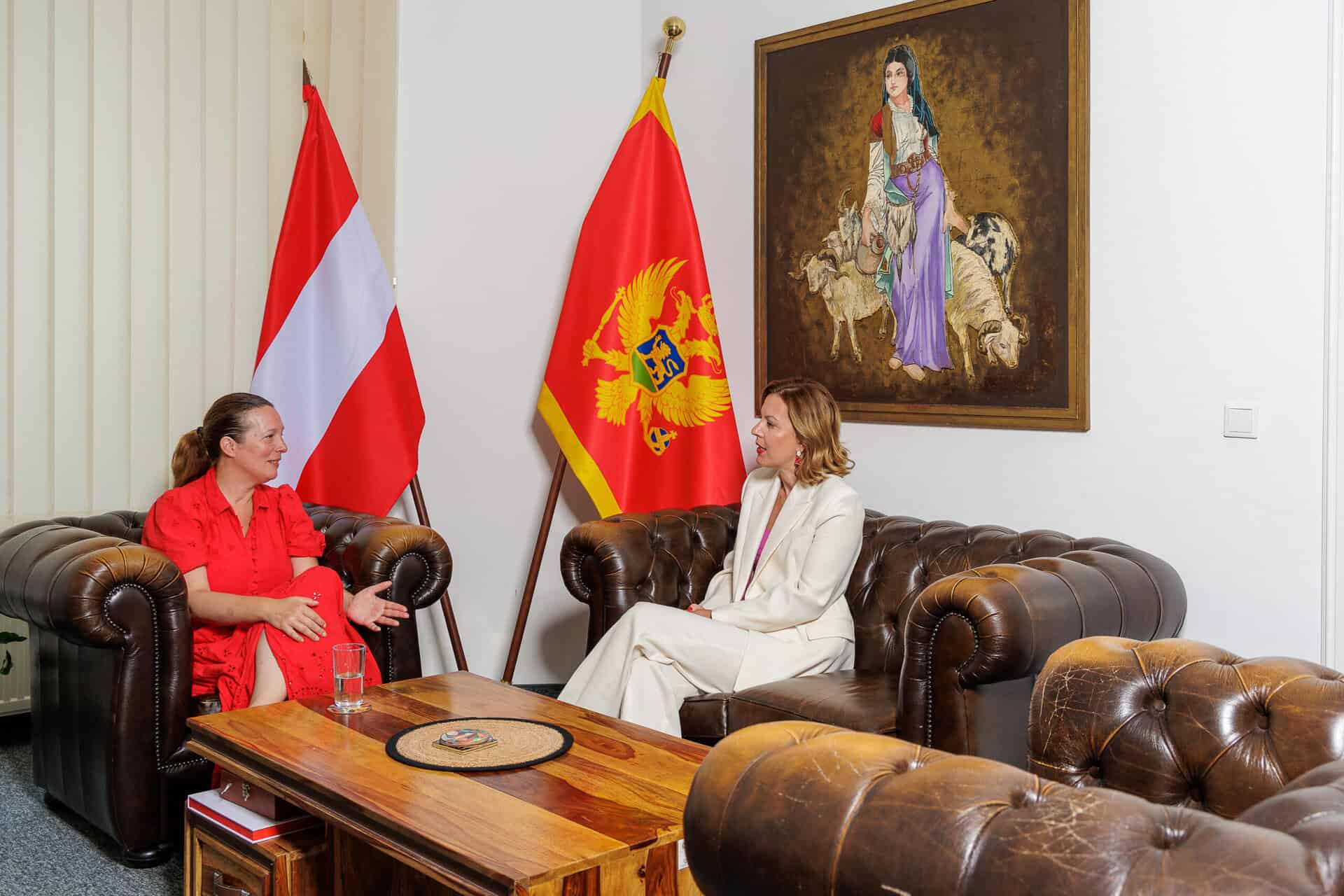
In an interview with Diplomatic SOCIETY, H.E. Stanica Andic looked back at the first year of her term as Ambassador of Montenegro to Austria and spoke about Montenegro’s EU accession process as well as the relations between Austria and her country.
You are representing Montenegro in Austria since last year – what have you already been able to achieve during this time, and what are your priorities for the remainder of your term?
This has been an intensive year in terms of strengthening relations between our two countries.
I am particularly pleased that, since my appointment one year ago, we have had a series of reciprocal high-level visits. Among these, I would particularly highlight the visit of Federal Minister Beate Meinl-Reisinger in July 2025, followed by the visit of Federal Chancellor Christian Stocker in August and his participation in the EU-Western Balkans Summit held in Tivat in June this year. The President of Montenegro, Jakov Milatović, and the Prime Minister, Milojko Spajić, visited Vienna in January this year, while the Deputy Prime Minister and Minister of Foreign Affairs, Ervin Ibrahimović, paid an official visit to Austria in April. Further, the President of the Parliament of Montenegro, Andrija Mandić, came to Vienna in September, while Prime Minister Spajić is expected to visit in November.
Over the past year, high-level exchanges have also taken place in the fields of education and science, the economy and finance, with particular emphasis on Austria’s support for Montenegro’s accelerated accession to the European Union. The agreements reached during these high-level interactions are a testament to the closeness of our two countries, while at the same time serving as a driving force for further deepening inter-institutional cooperation. Over time, this cooperation is expected to produce tangible results in the areas of economy and mutual investment, tourism exchanges, as well as the exchange of know-how and expertise.
Over this period, we have also worked to establish direct links between the Austrian and Montenegrin business communities, with a particular focus on Austrian Federal Provinces that are interested in investing in Montenegro or that can offer expertise relevant to the development of our economy. In this context, a group of Austrian business representatives from Styria visited Podgorica in June, while representatives of local government and management structures in Montenegro visited Tyrol in May.
Building on the existing foundations of our rich history of cultural, economic and diplomatic ties, my focus will continue to be on further enriching and deepening these relations. Austria is already among the ten largest investors in Montenegro, and we expect it to move even higher up that ranking. We also expect the sustained growth in the number of Austrian tourists visiting Montenegro to continue, as well as the establishment of strong and lasting ties between our two business communities, an area on which we are working with great dedication.

As you just mentioned, relations between Montenegro and Austria are close and cooperative – in which areas do you see potential for further cooperation?
Our two countries share close and long-standing bonds, which are today being further strengthened and deepened. Austria and Montenegro continue to cooperate closely at the multilateral level, as we share the same values and principles. Austria is a strong supporter of the EU enlargement towards the Western Balkans and, over the years, has been a genuine and steadfast friend of Montenegro in pursuing this strategic objective.
At the bilateral level, our two governments are connected across almost every institutional area, with our respective ministries and institutions cooperating directly in the fields of education, healthcare, internal affairs, justice and defence. Nevertheless, there is still significant untapped potential for further strengthening these ties, particularly in the areas of economic cooperation and foreign direct investment. Austria has been present for decades as one of the key investors in the Western Balkans, particularly in the financial sector. Given our growing needs, which go hand in hand with the reforms we are implementing as part of our EU accession agenda, we see considerable potential for greater engagement by Austrian companies with expertise in the fields of energy, infrastructure, environmental protection and spatial planning. This also includes projects related to waste management, hydropower and wind farms, as well as the rehabilitation of wastewater infrastructure and railway networks.
Montenegro remains committed to maintaining a secure, reliable and predictable environment for foreign investors, who enjoy the same rights and benefits in Montenegro as domestic investors. Energy remains one of the key drivers of Montenegro’s economic growth, which is why Montenegro is expanding its capacity for renewable energy sources and investing in green infrastructure that will connect Montenegro more closely with European energy markets. All of this provides a strong foundation for continuing our efforts to further deepen and strengthen our bilateral cooperation with Austria.
Montenegro stands as the clear frontrunner for EU enlargement – how does your country plan to close its remaining negotiating chapters for EU accession? How would you describe the public’s stance on this?
I am confident that Montenegro will become the next member of the European Union by 2028. Our agenda is clear, and I believe we will achieve this goal by maintaining the same level of determination and commitment in the final stage of the process, while continuing to deliver tangible and measurable results. Our progress is being underpinned by coordinated institutional action, strong political ownership, and increasingly dynamic accession negotiations. Our objective is to complete the technical part of the accession process and close all 33 negotiating chapters with the EU by the end of this year. My confidence in our ability to achieve this is reinforced by the intensity and dedication with which our public administration is working to fulfil its responsibilities, as well as by the clear and unequivocal messages we continue to receive from the highest levels in Brussels and from the capitals of EU Member States.
I consider the launch of the process of drafting the Accession Treaty to be a particularly positive signal. Equally significant is the European Commission’s proposed financial package for Montenegro’s future accession. I see this progress not simply as the result of institutional efforts, but as a reflection of a broader commitment across Montenegrin society.
European Union membership is a transformative process that strengthens democratic institutions and accelerates reforms. I believe that this transformation is already visible. It is also reflected in the consistently high level of public support for EU membership among our citizens, which has remained at between 70 and 80 percent. To me, this is particularly important because it demonstrates that European integration remains a unifying national priority.
There is a broad political consensus in Montenegro on the importance of EU accession. This was reaffirmed by the unanimous adoption of the Resolution on the Integration of Montenegro into the European Union by the Parliament of Montenegro on 3 March 2026, through which Members of Parliament once again confirmed that Montenegro’s accession to the EU remains a key strategic objective of our country. In the coming months, all institutional capacities will remain focused on finalizing legislative alignment, strengthening implementation capacities, and delivering measurable results across all remaining negotiating chapters.
All of this is closely connected to your country’s foreign policy – can you tell us a little bit more about it? What are its main pillars?
Our foreign policy is primarily focused on advancing the strategic objectives of Montenegro, guided by the values and principles upon which modern democratic societies are founded. As I have already stated, Montenegro will remain fully committed to becoming a member of the European Union. Future EU membership is an important prerequisite for the further sustainable development of our country, opening the way towards greater prosperity and new opportunities. At the same time, Montenegro’s membership can also be viewed as an instrument of regional transformation, as it would have a far-reaching and positive impact on the other candidate countries.
Montenegro has been a NATO member since 2017. Over the past decade, we have proved to be a credible and reliable partner, and we will continue to be one. Fulfilling our commitments within the Alliance, as well as contributing to collective security, remains among our key priorities. Montenegro’s security is inextricably linked to the security of the Western Balkans and Europe as a whole. Therefore, our country has an important role to play as an active promoter of dialogue, cooperation, and our shared Euro-Atlantic and European values. Montenegro remains committed to continuously strengthening its capabilities, primarily by increasing defence spending, modernising the Armed Forces of Montenegro, and fulfilling NATO capability targets.
Since the restoration of our independence in 2006, we have attached particular importance to continuously strengthening relations with our neighbours. This is a key pillar of our foreign policy, and it is one of the reasons why Montenegro is recognised, both in the region and beyond, as a country that actively contributes to the stability of the Western Balkans.
Our goal also remains to further strengthen Montenegro’s role at the multilateral level through active participation in International Organisations such as the United Nations, the OSCE and the Council of Europe. Through these activities, Montenegro reaffirms its commitment to multilateralism, the protection of human rights, and contributing to global peace and sustainable development.
Montenegro was the world’s first constitutional “ecological state” but critics argue that there is a gap between the green vision and the reality – what is Montenegro actively doing to protect the environment?
35 years ago, Montenegro enshrined the concept of an ecological state in its Constitution, which at the time represented a clear vision of where we saw ourselves and the direction in which we wanted to develop and pursue reform. Our natural resources, beautiful mountains, lakes and the sea, represent an enormous potential, and through this constitutional commitment, we further pledged to continue working to preserve it. This entails greater and targeted investment in renewable energy sources, green technologies and waste management, as well as strengthening national mechanisms to combat climate change. The reforms that Montenegro is implementing as part of its European Union accession process, particularly within Negotiating Chapter 27, which covers the environment and climate change, are bringing us closer to this goal. We will remain fully committed to further reducing the gap between our ecological vision and its implementation, and one of the most reliable and measurable indicators of our progress will be the closure of this negotiating chapter with the European Union. At the same time, it is important to recognise that this is a continuous and highly demanding process, one that requires significant investment and, in reality, never truly comes to an end.